“Without data, you’re just another person with an opinion.”
This quote by American Industrialist W. Edwards Deming, highlights the critical role of data-driven decision-making.
With the global Business Intelligence (BI) market set to hit approximately $55.48 billion by 2026, and the Advanced Analytics sector projected to soar from $79.77 billion in 2022 to an astounding $434.60 billion by 2030, its clear businesses are increasingly harnessing data’s immense potential. But choosing between BI and Advanced Analytics isn’t about chasing trends it’s about understanding which approach aligns best with your company’s strategic goals.
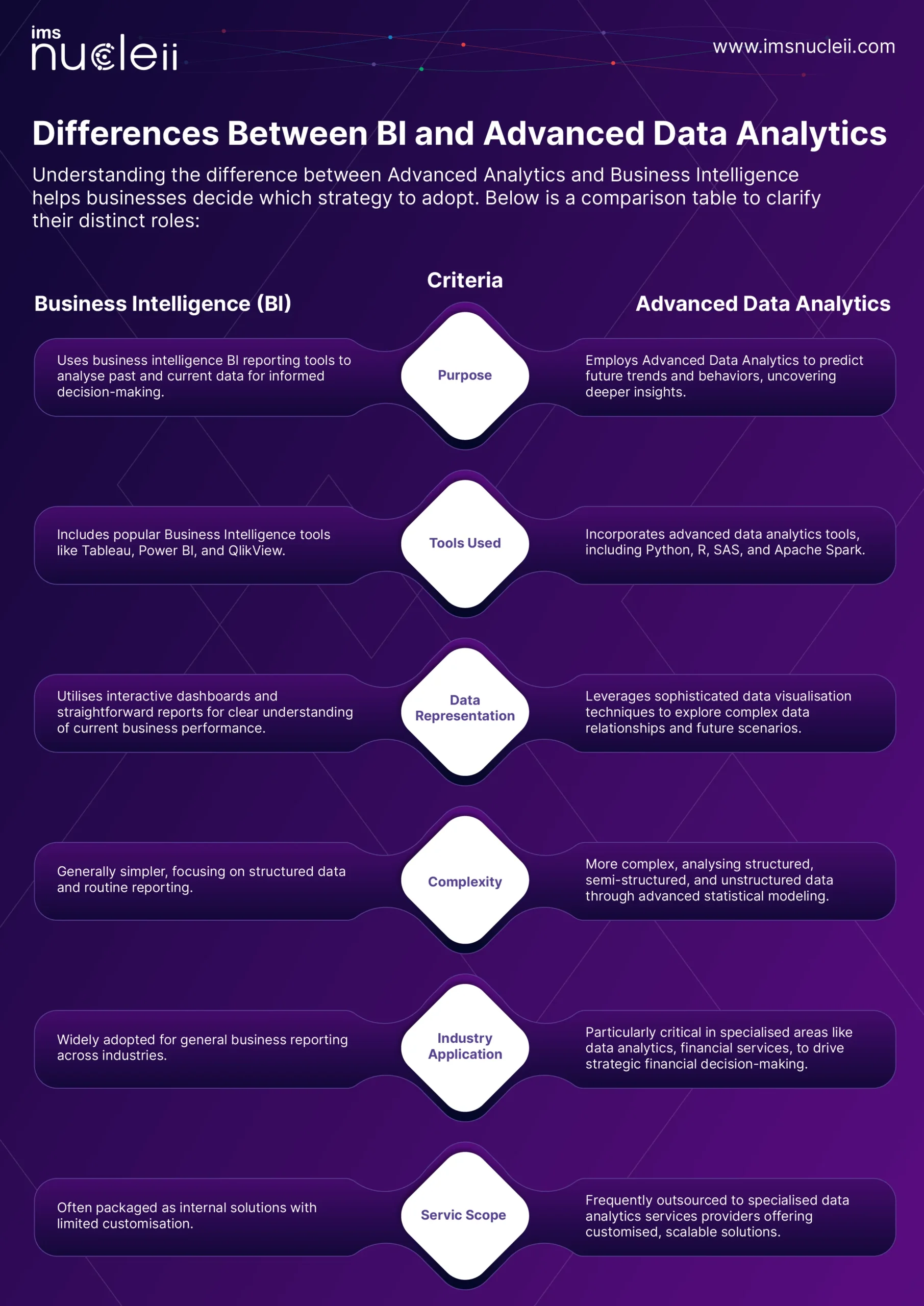
Business Intelligence delivers clarity on what’s happening now through accessible, actionable insights, while Advanced Analytics propels you into the future, predicting opportunities and risks before they arise. So, which one is right for your business or could a strategic blend of both be the key to unlocking sustained competitive advantage?
What is Business Intelligence?
- Business Intelligence (BI) refers to the strategies, technologies, and business intelligence tools that organisations use to collect, integrate, analyse, and present business information. Its primary goal is to support better decision-making by providing comprehensive reports and real-time insights into business operations.
- By consolidating data from multiple sources, Business Intelligence BI reporting tools offer a clear view of historical and current performance. This empowers companies to make informed decisions based on accurate data.
Major Advantages of Business Intelligence
- Improved Decision-Making: Through real-time data analysis, businesses make swift, informed decisions.
- Increased Operational Efficiency: By identifying inefficiencies, businesses can streamline processes and reduce operational costs.
- Enhanced Data Quality: Integrating various data sources ensures data consistency and accuracy.
- Competitive Advantage: Gaining insights from market trends and opportunities, businesses can stay ahead of competitors with timely decisions.
Limitations of BI
- Historical Focus: BI typically analyses past and current data without offering predictive insights.
- Data Dependency: Incomplete or inaccurate data can lead to skewed analyses.
- Limited to Structured Data: BI mainly processes structured data from internal sources.
Common Use Cases of BI
- Financial Reporting: Accurate financial statements and performance reporting are particularly valuable in data analytics financial services.
- Sales Analysis: Monitor sales trends and improve forecasting.
- Supply Chain Management: Optimise inventory and supplier performance.
- HR Analytics: Assess employee performance and retention strategies.
What is Advanced Data Analytics?
- Advanced Analytics takes data analysis to the next level. Unlike traditional BI, Advanced Data Analytics employs complex statistical methods, machine learning, and predictive modelling to examine large data sets. It helps businesses predict future outcomes, uncover patterns, and gain deeper insights.
- By leveraging Advanced Analytics, organisations move beyond understanding “what happened” to predicting “what will happen” and “why it will happen.” This foresight enables proactive decision-making and innovation.
Key Benefits of Advanced Analytics:
- Predictive Insights: Advanced Analytics forecasts trends, helping businesses anticipate market shifts and customer behaviours.
- Personalised Customer Experiences: Businesses use Advanced Analytics to tailor offerings based on customer data.
- Risk Mitigation: Detect potential risks and anomalies early, reducing operational and financial risks.
- Innovation and Growth: Deep data analysis often reveals new product, service, and business model opportunities.
Limitations of Advanced Data Analytics
- Complex Implementation: It requires skilled data scientists and advanced data analytics tools list to implement.
- Resource Intensive: Advanced Analytics demands significant computational power and time investment.
- Data Quality Dependency: As with BI, poor data quality can compromise the insights generated.
Common Use Cases for Advanced Analytics:
- Fraud Detection: Identify suspicious activities using pattern recognition.
- Customer Segmentation: Group customers for targeted marketing campaigns.
- Predictive Maintenance: Anticipate equipment failures and schedule timely repairs.
- Healthcare Diagnostics: Predict diseases and health risks for better patient outcomes.
IMS Nucleii: Your Partner for Business Intelligence and Advanced Data Analytics
At IMS Nuclei, your managed IT solution provider, we understand that transforming raw data into actionable intelligence is important for businesses aiming to thrive in the present business scenario. Our expertise in Business Intelligence and Advanced Data Analytics empowers companies to harness their data for strategic advantage.
We provide customised solutions tailored to your unique needs. Our Business Intelligence services deliver crystal-clear reporting and interactive dashboards that simplify complex data, enabling informed decision-making. We consolidate data from diverse sources, ensuring accuracy, consistency, and real-time insights to boost operational efficiency.
On the Advanced Analytics front, IMS Nuclei employs leading-edge techniques, including predictive modeling, machine learning, and sophisticated statistical analyses. Our analytics solutions help businesses anticipate market trends, mitigate risks, personalise customer experiences, and uncover hidden opportunities for innovation and growth.
Whether your goal is immediate clarity through Business Intelligence or future-ready insights through Advanced Analytics, IMS Nuclei positions your organisation to turn data into a strategic asset for sustained competitive advantage.