Artificial Intelligence (AI) and Machine Learning (ML) have become two of the most talked-about technologies since a decade. While many people tend to use these terms interchangeably, the reality is that they represent different concepts with overlapping applications.
For business leaders, entrepreneurs, and even curious professionals, understanding the differences between AI and ML is more than a technical exercise, it’s about making smarter decisions on where and how to adopt these technologies for maximum business impact.
In this article, we’ll break down AI vs Machine Learning, clear up the confusion, and highlight real-world use cases that are shaping industries today.
What is Artificial Intelligence (AI)?
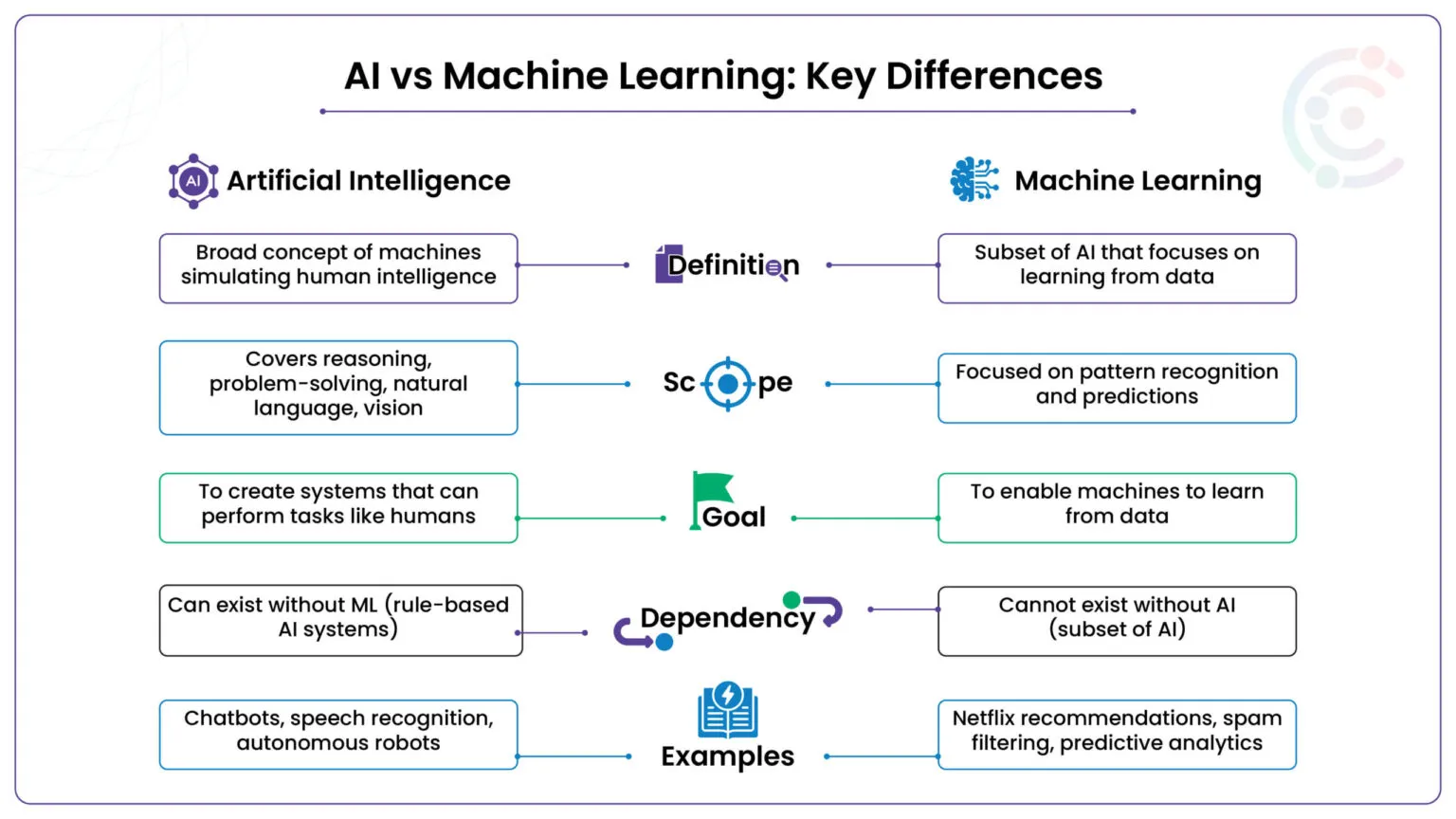
At its core, Artificial Intelligence is the science of creating machines that can mimic human intelligence. Think of AI as the broader concept that covers any technology capable of reasoning, problem-solving, decision-making, and learning from data or experience.
AI classificiation would be:
- Narrow AI (Weak AI): Designed for specific tasks like chatbots, facial recognition, or fraud detection.
- General AI (Strong AI): Hypothetical systems that could perform any intellectual task a human can do (still far from reality).
- Superintelligent AI: An advanced stage where machines surpass human intelligence (theoretical at this point).
Example: AI powers Google Translate, which doesn’t just translate words, it understands context, sentence structure, and meaning.
What is Machine Learning (ML)?
Machine Learning is a subset of AI. It focuses specifically on algorithms and models that allow machines to learn from data and improve performance without being explicitly programmed.
Instead of telling the system “if X happens, do Y,” ML allows machines to identify patterns in massive datasets and make predictions or decisions on their own.
Common ML Techniques:
- Supervised Learning: Models trained on labelled data (e.g., predicting credit scores).
- Unsupervised Learning: Models find hidden patterns in unlabelled data (e.g., customer segmentation).
- Reinforcement Learning: Algorithms learn by trial and error (e.g., self-driving cars).
Example: Netflix’s recommendation system uses ML to analyse viewing history and suggest shows you’re likely to watch next.
AI vs Machine Learning: Key Differences
To simplify, let’s look at a side-by-side comparison:
Real-World Use Cases of AI and ML
Let’s move beyond theory and see how AI and ML are shaping industries today.
1. Healthcare
- AI in Healthcare: AI-powered systems help doctors analyse medical imaging, assist in diagnosis, and even predict disease outbreaks.
- ML in Healthcare: Predicting patient re-admission risks or personalising treatment plans.
Example: IBM Watson uses AI to support oncologists by analysing cancer research papers and suggesting treatment options.
2. Finance & Banking
- AI in Finance: Fraud detection, automated trading, robo-advisors for wealth management.
- ML in Finance: Credit scoring, customer risk profiling, personalised financial recommendations.
Example: PayPal uses ML algorithms to detect fraudulent transactions in real-time.
3. Retail & E-commerce
- AI in Retail: Personalised shopping assistants, inventory management, and demand forecasting.
- ML in Retail: Recommendation engines, dynamic pricing models, churn prediction.
Example: Amazon uses ML for product recommendations and AI for managing its vast logistics network.
4. Manufacturing
- AI in Manufacturing: Predictive maintenance, supply chain optimisation, and quality control.
- ML in Manufacturing: Pattern recognition in machine sensor data to predict equipment failures.
Example: Siemens uses ML algorithms to predict industrial machines performance based on wear and uptime data , saving costs on downtime.
5. Marketing & Customer Experience
- AI in Marketing: Chatbots, voice assistants, and hyper-personalised ads.
- ML in Marketing: Customer segmentation, lead scoring, and sentiment analysis.
Example: Spotify leverages ML to create Discover Weekly playlists based on user behaviour.
Learn more about Unveiling the Marvels of AI and ML
Business Impact: Why This Distinction Matters
Understanding AI vs ML isn’t just about semantics, it influences how companies make investment decisions.
- Strategic Investments: Businesses need to know whether they require a broad AI solution (like automating customer service) or a focused ML solution (like predicting customer churn).
- Efficiency Gains: ML can drastically cut operational inefficiencies by predicting outcomes and reducing manual work.
- Competitive Edge: AI-powered personalisation creates customer stickiness and loyalty.
- Cost Optimization: Predictive analytics reduces waste, downtime, and resource allocation issues.
- Scalability: AI-driven automation allows companies to scale processes without proportionally increasing costs.
Future Outlook: Where AI & ML Are Heading
While AI and ML have already revolutionised industries, the future promises even more impactful developments:
- Generative AI: Creating new content, text, images, music, at scale.
- Edge AI: Bringing AI closer to devices for faster processing (e.g., autonomous drones).
- Explainable AI: Increasing transparency and accountability in AI decision-making.
- AI + IoT Synergy: Smarter connected devices across industries.
Businesses that understand the difference between AI and ML, and use them strategically, will be better positioned to thrive in a tech-driven economy.
Many of our clients find that combining multiple services creates the most value for their organization. Discover how our integrated approach can address your specific business challenges.
FAQs
Q1: Is Machine Learning the same as Artificial Intelligence?
No. AI is the broader concept of creating intelligent systems, while ML is a subset that focuses on learning from data.
Q2: Can you have AI without Machine Learning?
Yes. Rule-based AI systems (like early chatbots) operate without ML.
Q3: Which is better for business, AI or ML?
It depends on the use case. ML is ideal for data-driven predictions, while AI is broader and handles reasoning, automation, and decision-making.
Q4: What industries use AI and ML the most?
Healthcare, finance, retail, manufacturing, and marketing are leading adopters of these technologies.
Q5: What is an example of AI that doesn’t use ML?
Expert systems that rely on pre-programmed rules instead of data-driven learning.