
Approximately 60% of businesses now use managed or co-managed IT services to reduce costs and boost operational efficiency. With the global managed services market projected to grow from USD 335 billion in 2024 to over USD 731 billion by 2030, mid-sized IT firms are under increasing pressure to scale strategically. Co-managed IT offers a hybrid model that blends in-house control with outsourced expertise, making it the wise choice for firms balancing capability with growth.
What Is Co-Managed IT (and How It Works)
What Is Co-Managed IT?
A co-managed IT model pairs a company’s existing IT team with a Managed Service Provider (MSP) to share responsibilities.
Rather than outsourcing all operations, this approach lets firms outsource only specific functions, such as help desk, security monitoring, or project support
How It Works?
The collaboration typically begins with an assessment of the internal IT team’s toolset, skill gaps, and workload.
Based on that, the MSP takes on agreed-upon services ranging from end-user support to IT security, creating a flexible partnership that quickly adapts to evolving needs.
Co-Managed IT vs Fully Managed IT: What is the difference?
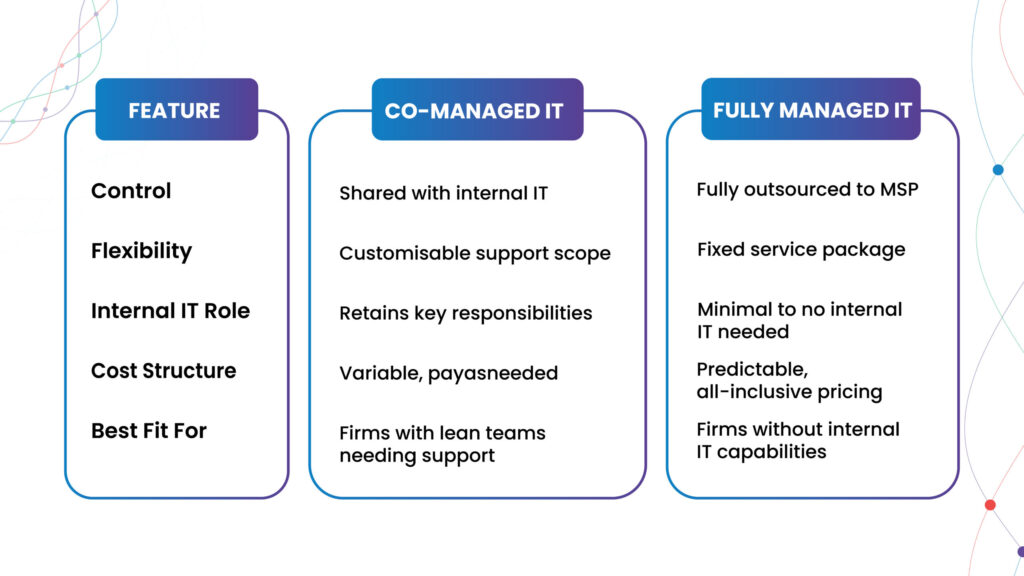
In managed IT, the MSP takes full ownership of a business’s IT infrastructure: everything from network management to strategic planning is outsourced.
Co-managed IT services involve a cooperative model: the internal team retains control over core functions while the MSP provides specialised support.
Different Managed IT Service Models:
When to choose?
Co‑managed IT is ideal for mid‑sized firms with existing IT teams seeking support in areas of expertise gaps or overflow. Fully managed services fit organisations lacking internal IT or aiming to focus exclusively on core operations.
Top 10 Advantages of Co-Managed IT Services for Mid-Sized Companies
1. Lower IT Operating Costs & Better ROI
By outsourcing only targeted functions, companies reduce headcount and infrastructure expenditure while accessing expanded expertise. This results in strong cost efficiency and improved ROI.
2. Enhanced Cybersecurity & Compliance
Co-managed IT can furnish continuous threat monitoring, audits and compliance controls—critical for industries with stringent regulations.
3. 24/7 Monitoring & Faster Response
MSPs can extend service availability beyond regular hours. With round-the-clock monitoring and defined SLAs, incident response is significantly faster.
4. Access to Enterprise Grade Tools
MSPs bring advanced automation, ticketing platforms and monitoring tools that may be otherwise costly. This enables in-house IT to perform with enterprise-grade capabilities.
5. Scale on Demand for Projects & Overflow
Whether tackling cloud migrations or high-volume support requests, MSPs can flexibly scale resources to meet demand without long-term hiring.
6. Reduced Downtime & Proactive Maintenance
Ongoing health checks and proactive maintenance by MSPs reduce system failures and disruption, preserving uptime and preventing productivity losses.
7. Stronger Strategic Focus for In-House IT
With routine or specialised tasks offloaded, internal teams can dedicate effort to innovation, infrastructure strategy and core business priorities.
8. Improved End-User Experience (Help Desk CSAT)
Co-managed models often enhance help desk responsiveness and user satisfaction by blending internal context with external staffing support.
9. Faster Cloud & Microsoft 365 Road-Map Execution
Projects like cloud deployments or M365 upgrades become more efficient, as MSPs augment internal teams with specialised skills and resources.
10. Governance, Reporting & Accountability
MSPs bring robust SLA-driven reporting, KPIs and governance frameworks to track performance and ensure accountability.
How to Choose a Co-Managed IT Partner
Key questions to ask an MSP include:
- What is your average response time and SLA?
- Do you support outside office hours?
- Which compliance frameworks are in place?
- Can services scale up or down as needed?
- Do you have relevant certifications or case studies?
Ensure that the MSP aligns with culture, expectations, communication style, and governance from day-one.
Why Choose IMS Nucleii?
IMS Nucleii, an offshore managed IT support provider, delivers a distinctive co-managed IT partnership. Leveraging global talent pools and cost-effective operations, IMS Nucleii enables mid-sized IT firms to scale support and expertise without the overhead of on-shore hires. The offshore managed IT support model ensures flexibility, reliability and strategic focus – all while maintaining in-house control and driving strong ROI.
The Right MSP Partner Does not Replace You—It Reinforces You
FAQs
What are co-managed IT services, and how do they work?
Co-managed IT services are a hybrid model combining internal IT capabilities with external MSP support. They assign tasks based on in-house capacity and MSP strengths to optimise efficiency and control.
How is co-managed IT different from fully managed IT?
Fully managed IT outsources all IT operations. In contrast, co-managed IT retains internal governance while outsourcing selected functions—offering flexibility and focused investment.
Is co-managed IT a fit for mid-sized companies with a small IT team?
Yes. This model supplements small internal teams by providing scalable resources and expertise without the need to hire full-time staff.
What does a co-managed IT provider actually do day-to-day?
They may handle tasks such as proactive monitoring, help desk triage, security assessments, patch management, and assisting with IT projects—all of which complement the internal team.
How much do co-managed IT services cost vs hiring in-house?
Co-managed IT costs remain flexible and typically lower than hiring new staff; you pay for select services or hours, avoiding salary and benefit overheads.


