An executive evaluation of healthcare data architecture, real-time AI extraction, and FHIR interoperability. Discover how health systems eliminate mapping latencies, unlock dark physician notes, and improve bedside patient safety.
For Chief Medical Information Officers (CMIOs), health system CTOs, and clinical transformation leaders, modern healthcare presents a stark architectural paradox.
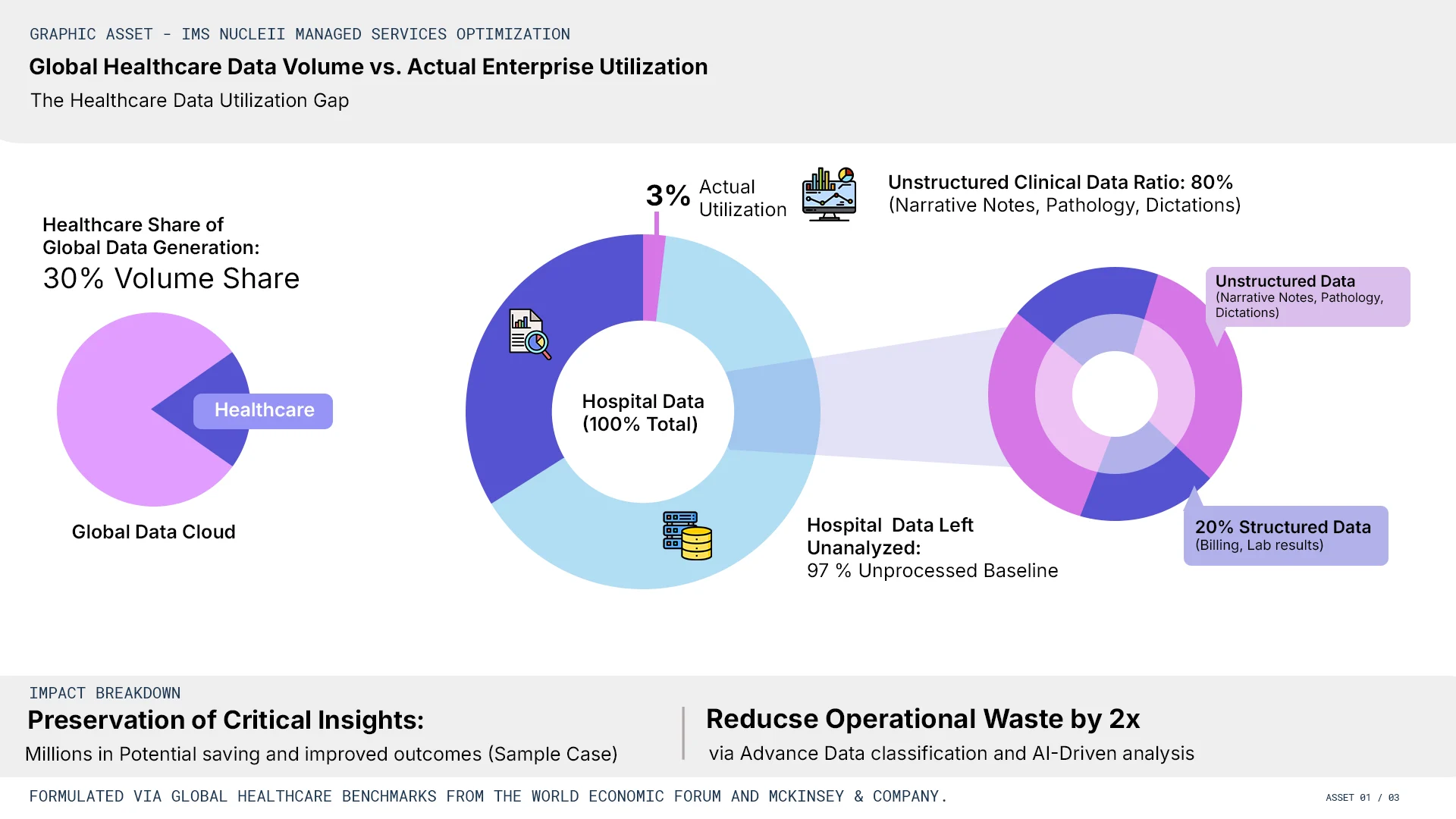
The healthcare industry generates 30% of global data volume. Yet, despite billions of dollars invested in enterprise Electronic Health Record (EHR) platforms, hospital systems remain severely data-starved at the point of care: 97% of all data produced by hospitals is left completely untouched or unanalyzed.
This utilization gap is caused by two structural bottlenecks: extreme data volume and disconnected operational silos.
Up to 80% of a patient’s medical history exists in unstructured formats—physician narrative notes, scanned discharge summaries, dictations, and pathology reports. Because traditional EHR systems cannot parse raw narrative text automatically, critical clinical context remains hidden.
To improve patient outcomes and accelerate clinical decision velocity, enterprise health systems are deploying AI extraction pipelines and HL7 FHIR schemas to convert unstructured narrative text into real-time, actionable intelligence.
The Unstructured Bottleneck: Why 97% of Hospital Data Remains Dark
The primary barrier to real-time clinical intelligence is not a lack of data collection; it is the inability to process unstructured text at scale.
When a patient enters an acute care facility, physicians, nurses, and specialists generate dozens of narrative progress notes daily. These documents contain essential nuances—such as subtle shifts in patient symptoms, drug allergies, secondary diagnoses, and anatomical findings.
However, legacy analytics tools require structured, tabbed database entries. As a result, critical information buried in unstructured text goes unread by secondary care teams, leading to delayed diagnoses, redundant testing, and preventable adverse events.
Attempting to solve this challenge through manual chart abstraction requires armies of clinical reviewers, adding millions in overhead while introducing multi-day reporting lags that make real-time intervention impossible.
Real-Time AI Extraction: Diagnoses, Dosages, and Anatomical Findings
Bridging the clinical data gap requires transforming unstructured text into discrete, machine-readable metrics instantly.
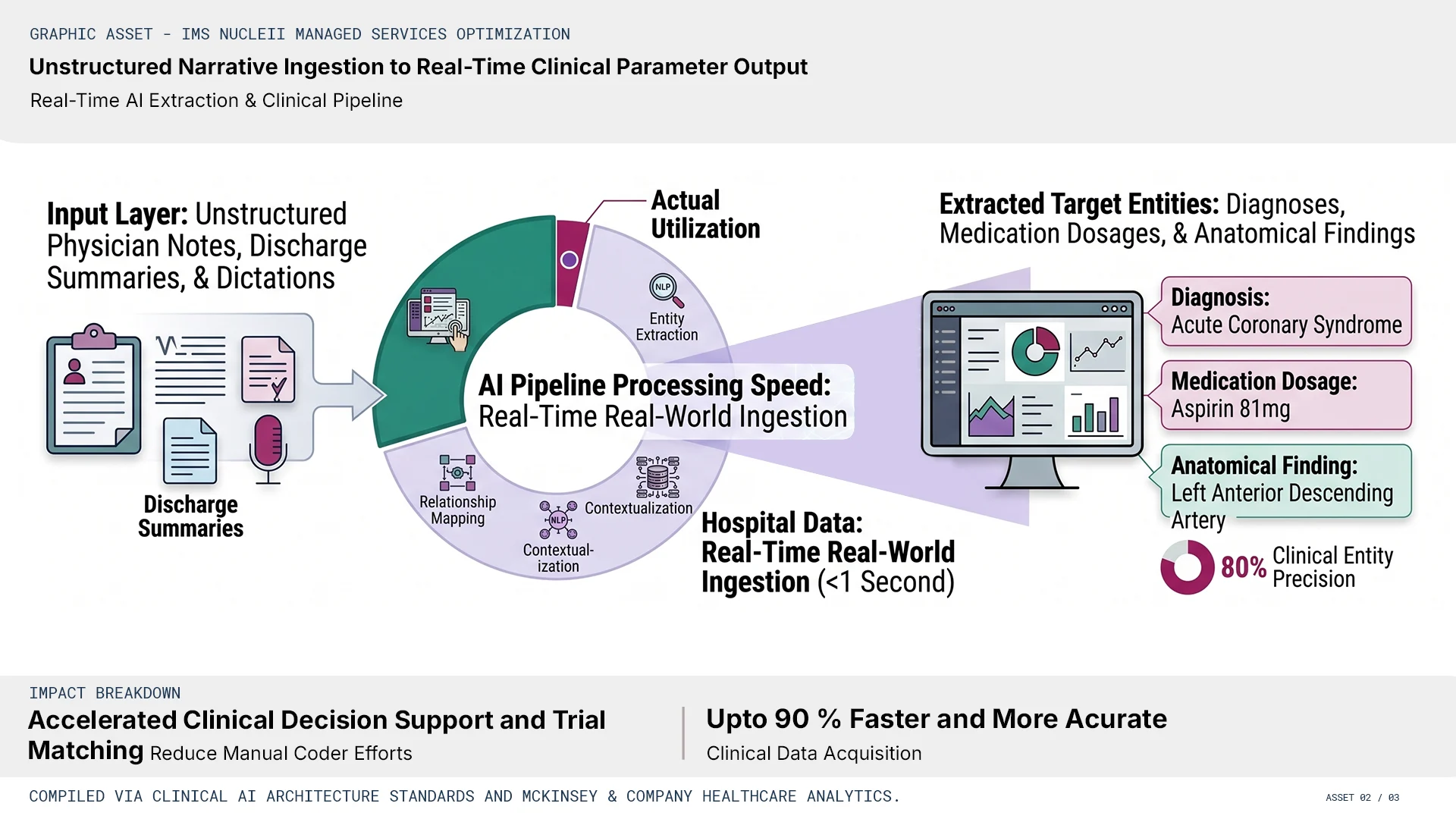
By deploying specialized Natural Language Processing (NLP) and multimodal AI pipelines directly onto incoming clinical data streams, health systems automatically parse narrative text as it is dictated.
Rather than relying on manual coding, AI extraction pipelines isolate and structure critical clinical entities in real time:
- Exact Medication Dosages: Extracting complex titration schedules, administration routes, and dosage modifications to prevent adverse drug interactions.
- Primary and Secondary Diagnoses: Identifying clinical conditions mentioned within narrative text before formal billing codes are assigned.
- Anatomical Findings: Structuring imaging text and surgical notes to highlight specific anatomical anomalies or disease progression markers.
Extracting these parameters at the moment of dictation gives clinical decision support (CDS) systems immediate visibility into patient risk profiles.
Eliminating Mapping Latency: Standardizing with FHIR Schemas
Extracting clinical entities is only half the solution; structured metrics must also be transmitted instantly across disparate hospital software systems.
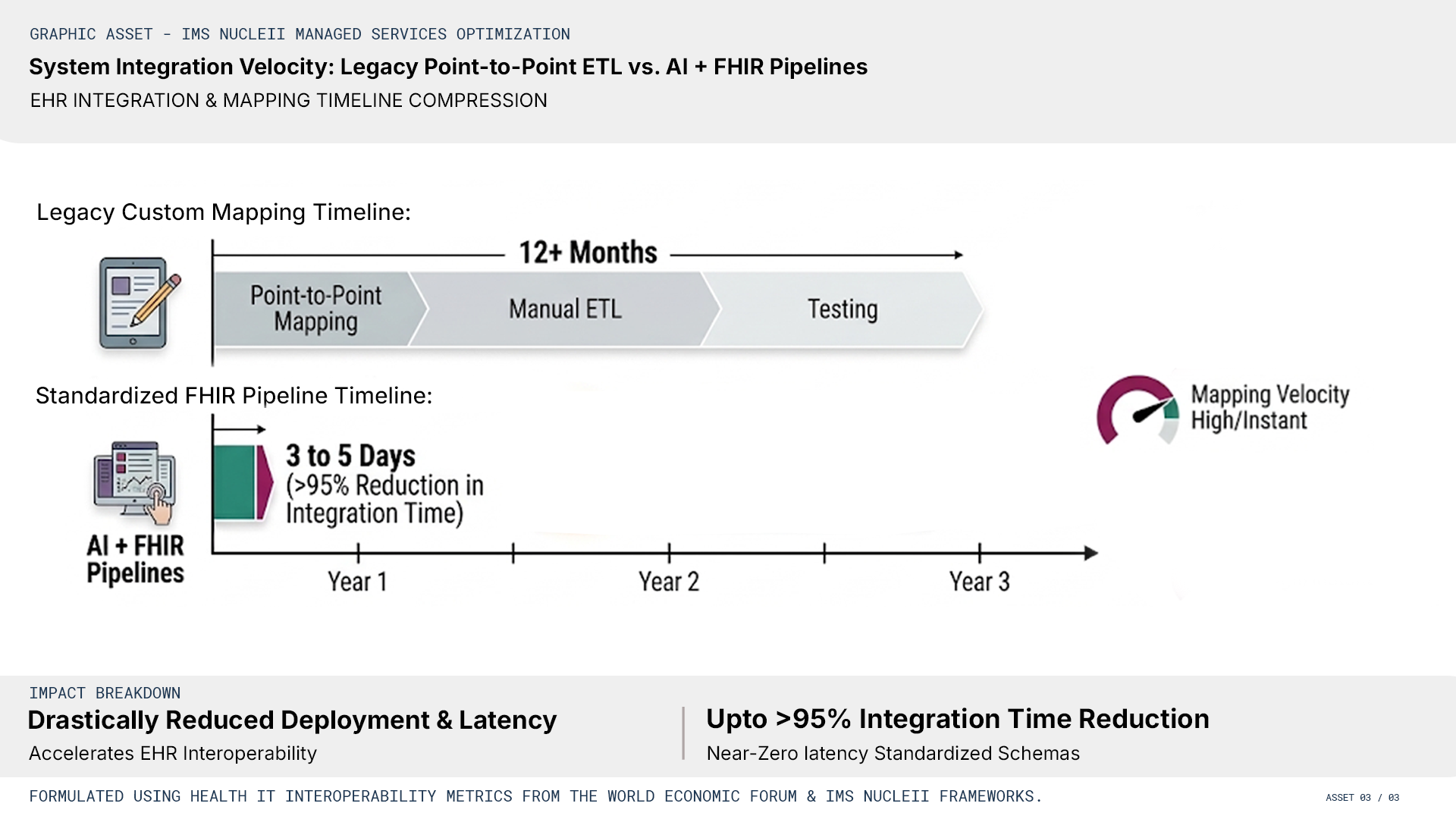
Historically, connecting new clinical software or AI models to an enterprise EHR required custom, point-to-point Database Mapping and Extract-Transform-Load (ETL) scripts. These legacy custom integration projects typically suffer from year-long development timelines and severe data mapping latencies.
Standardizing extracted data into HL7 FHIR (Fast Healthcare Interoperability Resources) schemas eliminates integration friction entirely:
- Removing Mapping Latencies: FHIR provides a standardized, resource-based API structure for clinical objects (e.g., Patient, Condition, MedicationRequest), eliminating custom schema translation layers.
- Timeline Compression: Deploying standardized FHIR pipelines compresses software deployment and system integration timelines from 12+ months down to mere days.
- Enterprise Interoperability: Standardized data flows seamlessly across multi-hospital networks, lab systems, and pharmacy databases, giving clinicians a unified, 360-degree patient view at the bedside.
Value Proposition: Operationalizing Enterprise Healthcare AI with IMS Nucleii
Converting fragmented clinical data into improved patient outcomes requires a specialized data architecture and integration partner. This is the exact technical capability delivered by IMS Nucleii.
IMS Nucleii acts as an enterprise data architect and technology partner, helping health systems, digital health platforms, and medical providers unify their data footprints and operationalize enterprise AI:
- Real-Time AI Extraction Pipelines: We build custom NLP and AI ingestion pipelines that parse unstructured narrative notes, automatically extracting diagnoses, dosages, and anatomical findings in real time.
- FHIR Interoperability & Data Unification: We design and deploy standardized FHIR data layers that eliminate mapping latencies, connecting disconnected EHR silos and cutting software integration timelines from months to days.
- Enterprise AI Operationalization: We manage your underlying cloud infrastructure, security compliance (HIPAA/GDPR), and model pipelines, allowing your clinical teams to deploy decision support tools safely and at scale.
Stop letting 97% of your healthcare data sit unused. Unify your healthcare data and operationalize enterprise AI by contacting our solutions team at [email protected] or visiting IMS Nucleii Enterprise Solutions today.
Key Takeaways
- The Healthcare Data Crisis: Healthcare generates 30% of global data, yet 97% of hospital data remains untouched due to high volume and disconnected silos.
- Real-Time AI Extraction: Modern AI pipelines automatically parse unstructured narrative notes to extract critical diagnoses, exact dosages, and anatomical findings instantly.
- Eliminating Mapping Lags: Utilizing standardized HL7 FHIR schemas removes data mapping latencies and cuts deployment timelines from 12+ months down to days.
- Unified Clinical View: Converting dark text into standardized APIs provides bedside clinicians with complete patient context, directly improving care quality and patient safety.
Frequently Asked Questions (FAQ)
Why is 97% of hospital data left unanalyzed in traditional EHRs?
Most hospital data is generated as unstructured text (physician dictations, progress notes, pathology summaries). Traditional relational databases inside legacy EHRs cannot index or query raw narrative text without manual chart review, causing the data to remain isolated in system silos.
How do AI pipelines extract clinical parameters accurately without manual coding?
Advanced clinical NLP and multimodal AI models are trained on specialized medical ontologies (such as SNOMED CT, RxNorm, and ICD-10). These models parse sentence context, syntax, and clinical relationships in real time to isolate specific diagnoses, dosages, and anatomical findings directly from narrative notes.
What role does HL7 FHIR play in cutting integration timelines?
FHIR (Fast Healthcare Interoperability Resources) provides a standardized, universal API specification for health data. By outputting extracted AI parameters directly into FHIR resources, health systems avoid building custom, point-to-point database translation scripts, compressing year-long IT projects into days.
Sources and Citations
- World Economic Forum (WEF): Examine global health system data strategies in WEF: How to Harness Health Data to Improve Patient Outcomes.
- McKinsey & Company: Review healthcare AI and consumer experience insights in McKinsey: Harnessing AI to Reshape Consumer Experiences in Healthcare.
- Forbes Technology Council: Explore unstructured health data execution strategies in Forbes: From Strategy to Implementation: Leveraging Unstructured Health Data.
- IMS Nucleii Operations Portal: Access enterprise healthcare data solutions at the IMS Nucleii Enterprise AI & Data Unification Hub.