
An executive breakdown of the dual pressures facing technology providers in 2026. Discover how automation and proactive delivery decouple revenue growth from expensive technical hiring.
For technology business leaders and Managed Service Providers (MSPs), the classic operational playbook is breaking down. Historically, an outsourced IT support company scaled its revenues through linear headcount expansion—adding more tier-1 to tier-3 engineers as client account volumes grew.
In 2026, that cost-plus model has hit an economic brick wall.
MSPs and internal IT teams are caught in a severe “double squeeze.” On one side, escalating salaries for specialized cloud, cybersecurity, and AI talent are eroding gross margins. On the other side, mid-market and enterprise buyers are rejecting traditional hourly billing in favor of strict, outcome-based SLAs. To survive, technology leaders must transition from manual ticket handling to automated, proactive service architectures.
1. The Macro Squeeze: IT Talent Shortage Meets SLA Pressure
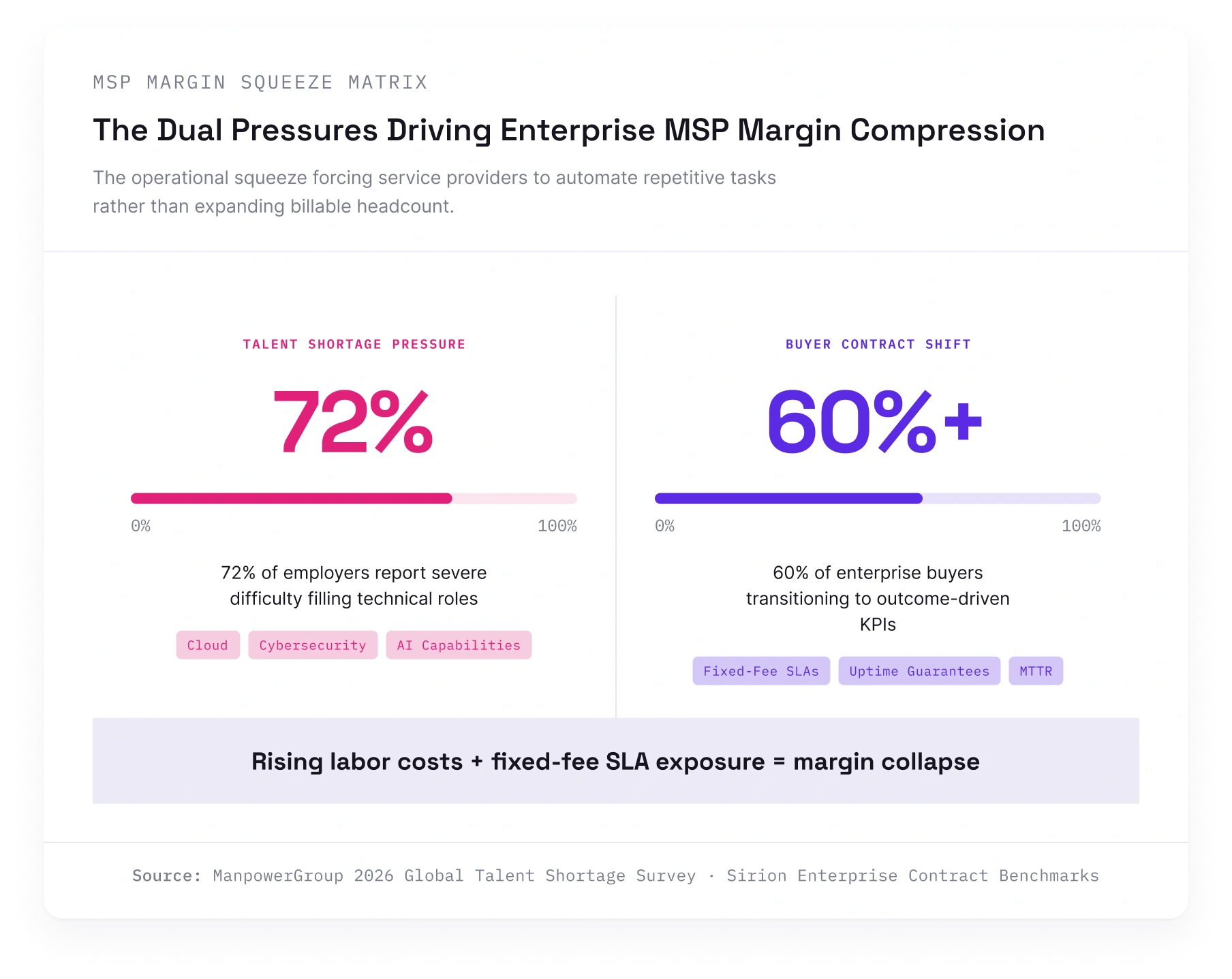
The primary operational constraint facing modern IT operations is not a lack of market demand; it is a severe structural labor bottleneck. According to the 2026 ManpowerGroup Global Talent Shortage Survey, 72% of employers report severe difficulty filling technical roles, with specialized cloud infrastructure, cybersecurity, and AI capabilities leading the global scarcity index.
Simultaneously, enterprise procurement teams have fundamentally changed how they evaluate technology contracts. Research across enterprise service agreements reveals that over 60% of enterprise buyers are actively transitioning from legacy cost-plus MSP contracts to outcome-driven KPIs. Clients no longer care how many hours an engineer spends troubleshooting a server; they demand guaranteed system uptime, zero breach exposure, and rapid mean-time-to-resolution (MTTR).
Trying to satisfy outcome-based SLAs purely through human labor in a market where 72% of technical roles remain unfilled inevitably leads to unsustainable salary inflation and margin collapse.
2. Decoupling Revenue from Headcount Through Automated Service Delivery
To defend gross margins, a modern managed IT services provider must decouple revenue growth from billable engineering hours. Sourcing an enterprise managed IT services framework allows organizations to automate up to 80% of routine L1 and L2 ticket volume—including password resets, patch updates, and basic endpoint configurations.
When an organization automates low-level maintenance, it achieves three vital operational outcomes:
- Salary Expense Stabilization: Senior engineers are insulated from routine helpdesk noise, keeping them focused on high-value architecture and billable strategic projects.
- Predictable SLA Execution: Machine-driven monitoring detects and resolves infrastructure anomalies before they cause client downtime.
- Scalable Delivery for Growth: Whether delivering managed IT services for small business accounts or co-managed enterprise stacks, client onboarding no longer requires immediate, expensive recruitment.
3. How IMSNucleiiRestores Profitability
Surviving margin compression requires a dedicated operational partner who can absorb routine technical volume under a predictable, fixed-cost structure. This is the core capability delivered by IMS Nucleii.
IMS Nucleii functions as a strategic execution engine for growing MSPs and enterprise IT departments, providing the specialized infrastructure and managed support needed to scale without adding overhead:
- Multi-Tiered L1–L3 Helpdesk Operations: We take complete ownership of your daily technical support pipeline under guaranteed, fixed-cost SLAs, clearing out ticket backlogs and insulating your core staff.
- Proactive Infrastructure Maintenance: Our automated management tools handle routine patching, system updates, and threat triaging around the clock.
- Margin Restoration: By shifting your baseline support overhead to IMS Nucleii, you lock in predictable operational expenses, allowing you to meet strict client KPIs while expanding profit margins.
Stop letting the talent shortage compress your profitability. Connect with our managed operations team at [email protected] to schedule an operational TCO audit and reclaim your margins today.
Key Takeaways
- The Double Squeeze: MSP margins are shrinking as a 72% talent shortage inflates salaries while 60%+ of buyers demand outcome-based, fixed-fee SLAs.
- Decoupling Growth: Sustainable profitability requires breaking the link between revenue expansion and expensive technical headcount.
- Automated Triage: Automating routine L1–L3 ticket queues protects senior engineering bandwidth for high-margin strategic work.
Frequently Asked Questions (FAQ)
1. How does the 72% IT talent shortage directlyimpactMSP profit margins?
When 72% of employers struggle to fill technical roles, competition drives up specialized salaries. MSPs operating on legacy, fixed-fee contracts absorb these higher labor costs directly, eroding gross profitability unless they automate routine tasks.
2. What is the difference between cost-plus and outcome-driven MSP contracts?
Cost-plus contracts bill clients based on time and labor spent. Outcome-driven contracts charge a fixed fee based on guaranteed performance metrics, such as 99.99% system uptime or 15-minute incident resolution windows.
Sources and Citations
- ManpowerGroup Research: The ManpowerGroup 2026 Global Talent Shortage Survey Analysis.
- Enterprise Contracting Analytics: Sirion’s Enterprise Contract Management KPIs and SLA Benchmarks.


