
In an era where agility, scalability, and security are no longer competitive advantages but business necessities, AWS Migration has emerged as a strategic move for enterprises across the globe.
With Amazon Web Services (AWS) being the market leader in cloud infrastructure, organizations are unlocking unprecedented business value by migrating their workloads to AWS, from reduced operational costs to improved performance and global reach.
According to a recent IDC study, businesses that successfully migrated to AWS reported an average 31% cost savings over five years, along with a 62% increase in IT staff productivity (Add Source). These outcomes are not just technological upgrades; they’re fundamental shifts in how organisations operate and scale.
Understanding AWS Migration
What is AWS Migration?
AWS Migration refers to the process of moving applications, databases, workloads, and IT infrastructure from on-premises or other cloud platforms to the AWS cloud. This migration enables businesses to take advantage of AWS’s scalable architecture, flexible services, and global infrastructure.
Common Triggers for Migration
Organisations typically consider AWS migration due to:
- Digital Transformation Goals – Accelerating cloud-first initiatives
- Cost Optimization – Reducing IT infrastructure and maintenance costs
- Global Expansion – Leveraging AWS’s worldwide data centres for low latency
- Performance Improvements – Utilizing advanced compute, storage, and networking capabilities
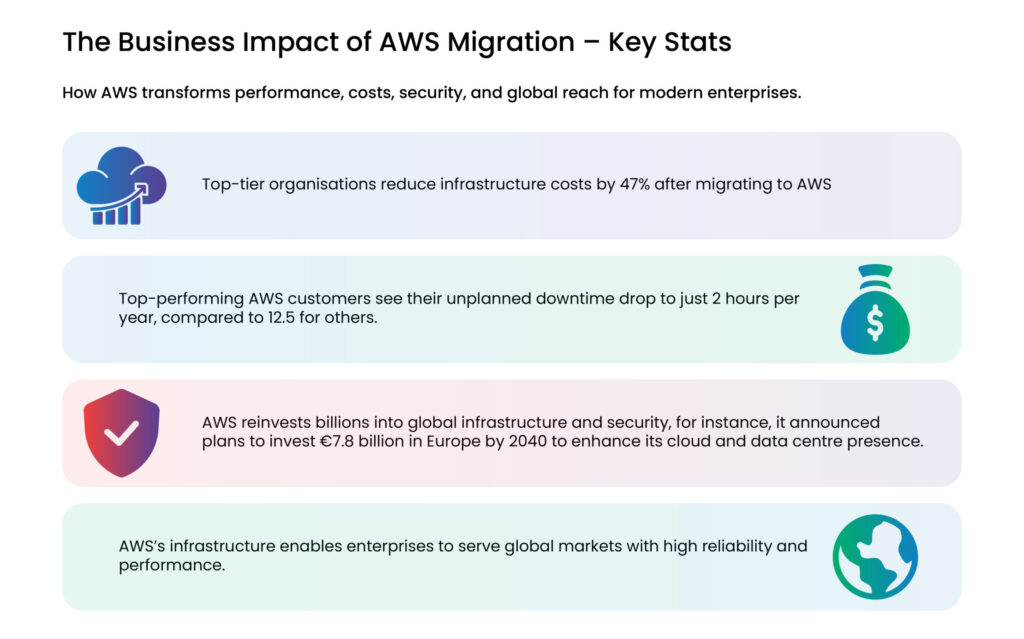
The Business Impact of AWS Migration
The business impact of AWS migration extends beyond IT benefits, it reshapes how organisations serve customers, manage resources, and plan for growth.
Scalability and Performance Gains
AWS offers elastic scalability, allowing businesses to increase or decrease computing resources based on demand. With Amazon EC2 instances, scaling up for peak loads or scaling down during low demand is both seamless and cost-effective.
Cost Efficiency and ROI
Moving to AWS allows companies to shift from a CAPEX-heavy model to an OPEX model, paying only for the resources they use. AWS’s pricing models, including Reserved Instances and Spot Instances, further enhance cost efficiency.
Security and Compliance Advantages
AWS is compliant with numerous industry standards like ISO 27001, SOC 2, and HIPAA, making it particularly valuable for regulated industries such as healthcare and finance. Its advanced encryption, Identity and Access Management (IAM), and threat detection tools ensure enterprise-grade security.
Global Reach Through Worldwide Data Centers
With AWS global data centres spanning 32 geographic regions and over 100 availability zones, businesses can deliver content and services with minimal latency to customers anywhere in the world.
AWS Migration Strategies for Maximum Business Value
AWS migration is not a one-size-fits-all process. Selecting the right AWS migration strategy ensures maximum ROI and business impact.
Rehosting (“Lift-and-Shift”)
This involves moving applications without changes. It’s faster and cost-effective for organisations looking for a quick transition with minimal disruption.
Replatforming
Here, minor optimisations are made during migration, such as upgrading the OS or database, while keeping the application core intact. This balances speed and performance enhancement.
Refactoring
Refactoring involves re-architecting applications to fully leverage AWS-native services like AWS Lambda or Amazon RDS. Though more complex, it maximises scalability and operational efficiency.
Hybrid Approaches
Some organisations adopt a hybrid migration strategy, maintaining certain workloads on-premises while moving others to AWS. This can be useful for regulatory compliance or staged migrations.
Core AWS Components That Drive Migration Success
Amazon EC2 Instances – The Backbone of Compute
Amazon Elastic Compute Cloud (EC2) provides resizable compute capacity in the cloud, enabling businesses to run applications without investing in physical hardware. EC2 supports a wide range of instance types optimised for different workloads, from general purpose to compute-intensive applications.
AWS Load Balancing – Ensuring High Availability
AWS Elastic Load Balancing (ELB) automatically distributes incoming traffic across multiple targets, such as EC2 instances, containers, and IP addresses. This improves application fault tolerance and ensures optimal performance even during traffic spikes.
Global Network of Data Centers – Low Latency, High Reliability
AWS’s vast network of worldwide data centres ensures that businesses can deploy workloads closer to their users. This results in lower latency, improved application performance, and compliance with local data residency requirements.
RealWorld Case Studies: How AWS Migration Transformed Businesses
3M (Manufacturing Giant)
3M migrated 2,200 applications over 24 months, moving over 6,200 EC2 instances to AWS with minimal downtime.
- Migrated 500 applications in just 12 hours, including a critical ERP system cutover in under 20 hours.
- Automated server deployment reduced provisioning time from weeks to minutes.
- Reported “millions of dollars in compute savings” through rightsizing and automation
A Multinational Bank (Financial Sector)
After migrating to AWS microservices architecture, the bank achieved:
- 50% faster time-to-market for new services
- 80% savings in service-related costs
- 3× higher operational efficiency
- Enhanced customer insights via a 360° portfolio view
Bswift (Health & Benefits Tech – US)
Completed migration of 600 servers across 11 environments in just 6 months (half the expected timeline).
- Realized 35% reduction in monthly hosting costs
- 29% reduction in server footprint
- 46% projected operational savings by end of 2024
Salsa Digital (Australia – F&B Platform)
Migrated legacy architecture to AWS and reduced Total Cost of Ownership by 72% in the first year:
- Production cost dropped from AUD 58,098 to 19,333 (≈66% saving)
- Disaster Recovery costs eliminated entirely, saving AUD 47,916 (~100%)
- Message throughput improved by 200%, with significantly reduced infrastructure scale.
Why These Metrics Matter
| Value Area | Impact Highlights |
| Speed & Scalability | Rapid application cutovers (e.g. 500 apps in 12 hours), automation of provisioning |
| Cost Reduction | 30-72% infrastructure savings, OPEX vs CAPEX shift |
| Operational Efficiency | Digital transformation enabling 3x better efficiency faster time-to-market |
| Business Growth Enablement | Greater agility, analytics capabilities, and global performance via AWS’s worldwide infra |
Challenges in AWS Migration & How to Overcome Them
Cost Estimation Pitfalls
Without proper planning, costs can exceed expectations. Businesses should leverage AWS’s Pricing Calculator and conduct a TCO analysis before migration.
Skill Gaps
Migrating to AWS requires cloud expertise. Partnering with experienced AWS migration consultants ensures a smoother transition.
Data Security During Transition
Using AWS’s built-in encryption and secure transfer protocols like AWS Direct Connect minimises the risk of data breaches during migration.
Conclusion – AWS Migration as a Strategic Growth Lever
AWS migration is more than a technical shift, it is a strategic enabler for innovation, scalability, and operational excellence. By choosing the right migration strategy, leveraging key AWS components like EC2, load balancing, and global data centres, and overcoming common challenges, businesses can unlock significant business value and maintain a competitive edge in the digital era.