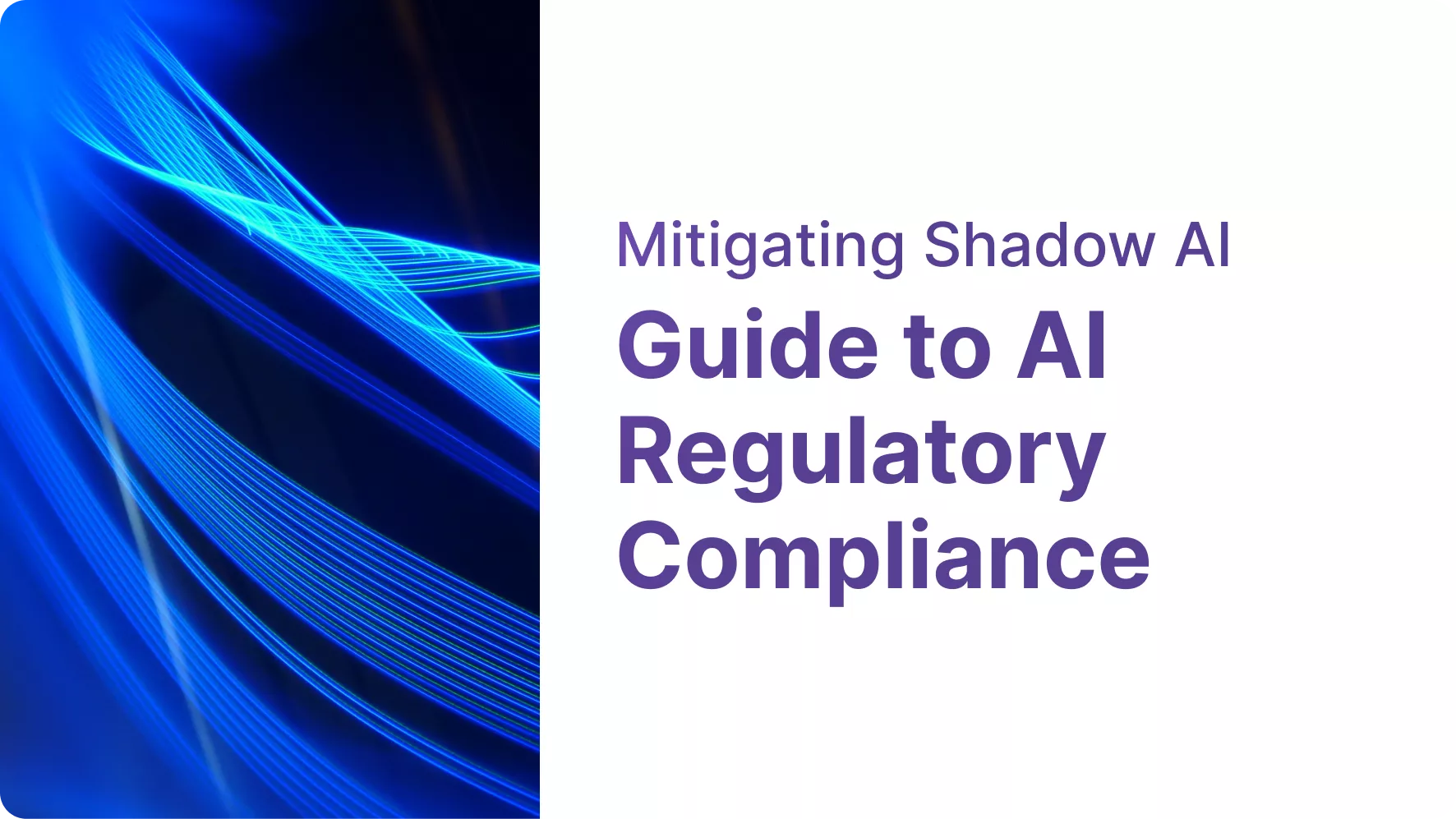
An executive guide to managing unmonitored employee AI usage, algorithmic transparency, and non-compliance penalties under the EU AI Act. Discover how structured governance insulates your enterprise from severe legal liabilities.
For C-suite executives and corporate legal officers, artificial intelligence adoption has evolved from an innovation challenge into a high-stakes legal risk. While generative AI tools promise massive productivity gains, ungoverned usage across internal teams—commonly known as “Shadow AI”—has created unprecedented corporate liability.
When employees feed proprietary source code, customer personal data, or confidential financial records into public AI models, they trigger immediate regulatory non-compliance. With major enforcement deadlines taking effect, maintaining an unmonitored AI footprint is no longer just an IT oversight; it is a direct threat to corporate valuation. Achieving true ai regulatory compliance requires moving beyond passive policy documents toward continuous, automated data controls.
1. The Shadow AI Threat: Unmonitored Data Ingestion and Regulatory Fines
The core danger of Shadow AI lies in data retention and model training mechanisms. Most public generative AI platforms automatically retain user prompts to train future iterations. When staff use unsanctioned tools for document summarization or coding assistance, sensitive data escapes corporate boundaries, causing catastrophic breaches of privacy frameworks like GDPR and the EU AI Act.
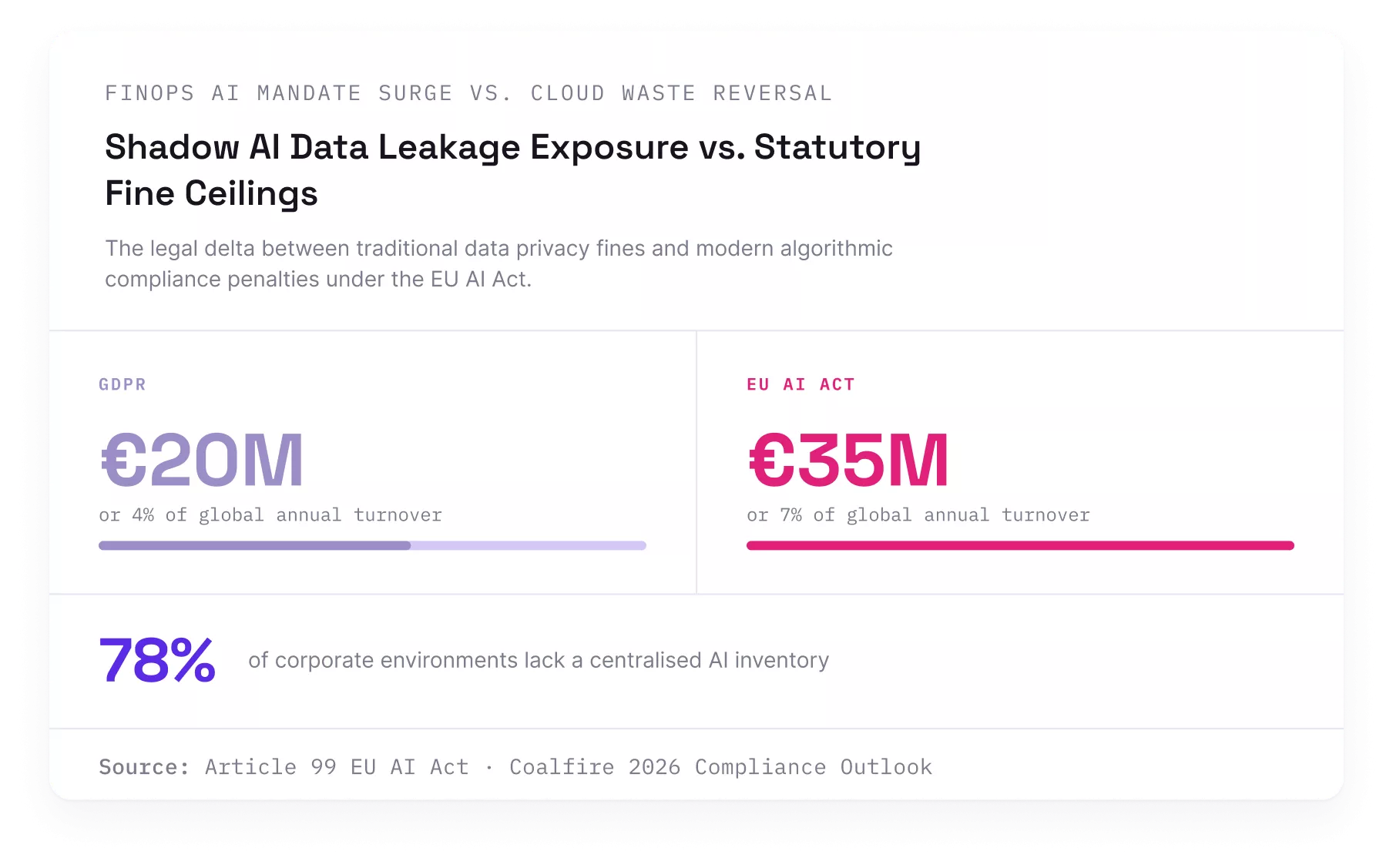
According to the Coalfire 2026 Compliance Outlook, regulators worldwide have shifted from evaluating policies to enforcing operational data controls. Under Article 99 of the EU AI Act, non-compliance with prohibited practices or unmanaged data ingestion carries administrative fines of up to €35 million or 7% of total worldwide annual turnover—substantially exceeding maximum GDPR penalty ceilings.
Securing eu ai act compliance requires organizations to maintain a real-time inventory of all AI tools in use, document training data provenance, and enforce strict administrative controls.
2. Enforcing Algorithmic Transparency and Responsible Governance
Achieving compliance requires establishing responsible ai governance across the entire software lifecycle. Regulators now demand strict algorithmic explainability, continuous logging, and clear disclosure whenever an AI system interacts with users or processes high-risk data.
To insulate your enterprise from regulatory enforcement, your risk framework must enforce three operational controls:
- Prompt Data Loss Prevention (DLP): Programmatically masking PII, trade secrets, and financial markers before prompts reach external LLMs.
- Algorithmic Logging & Traceability: Maintaining immutable audit trails of automated decision-making engines to satisfy regulatory inspection mandates.
- Vendor & Model Due Diligence: Ensuring third-party SaaS vendors disclose model training sources and offer administrative opt-outs for data retention.
3. Securing Your Enterprise with IMSNucleii
Building an internal governance team to track rapidly changing global AI laws is expensive and slow. Partnering with IMS Nucleii provides a scalable operational framework that turns complex compliance mandates into a sustainable business advantage.
At IMS Nucleii, we act as your strategic technology partner, delivering custom data governance as a service alongside robust managed IT infrastructure to eliminate regulatory exposure:
- Comprehensive AI Asset Discovery: We audit your hybrid environment to identify all unsanctioned Shadow AI tools, establishing a centralized, audit-ready AI inventory.
- Automated Guardrails & DLP: We integrate real-time prompt-masking, access controls, and logging mechanisms into your workflow pipelines to ensure strict ai regulatory compliance.
- Managed L1–L3 Helpdesk Operations: We manage your daily technical support overhead under fixed-cost SLAs, clearing helpdesk ticket backlogs and allowing your internal leadership to focus on core growth.
Stop letting Shadow AI expose your business to multi-million-dollar penalties. Connect with our compliance and architecture team at [email protected] to schedule an AI Risk & Governance Audit today.
Key Takeaways
- The Shadow AI Liability: Ungoverned employee AI usage creates immediate data leakage, violating core privacy laws and global regulatory frameworks.
- Severe Penalties: EU AI Act non-compliance carries statutory fine ceilings of up to €35 million or 7% of global turnover, far surpassing standard GDPR penalties.
- Proactive Oversight: Long-term resilience demands real-time AI asset discovery, algorithmic logging, and automated prompt DLP controls.
Frequently Asked Questions (FAQ)
1. What is Shadow AI, and why does it break GDPR and EU AI Act compliance?
Shadow AI refers to unsanctioned AI applications used by employees without IT approval. It violates compliance frameworks because user prompts often contain personal or proprietary data that is ingested by public LLM training datasets, causing unauthorized data transfers.
2. How does Data Governance as a Service help prevent regulatory fines?
Data Governance as a Service provides continuous automated monitoring, prompt-masking, and audit logging across your organization. This ensures all AI tools meet strict transparency and privacy standards, preventing unmanaged data leakage and audit failures.
Sources and Citations
- European Union Statutory Portal: Article 99 of the Official EU Artificial Intelligence Act.
- Coalfire Industry Analytics: Coalfire 2026 Compliance Outlook: AI, Privacy, and Global Risk Trends.
- IMS Nucleii Operations Portal: IMS Nucleii Enterprise Data Governance Hub.