An executive evaluation of RevOps, Customer Success, technical onboarding, and outcome-based pricing models. Discover how modern software leaders deploy autonomous agents to break the linear headcount ceiling, reduce cost-to-serve, and protect gross margins.
For Chief Executive Officers, Chief Operating Officers, and product leaders across the B2B SaaS landscape, the traditional expansion playbook has hit a structural wall.
For over a decade, software companies scaled their Annual Recurring Revenue (ARR) through a simple, linear formula: spend aggressively on customer acquisition, hire armies of Business Development Reps (BDRs) to log CRM activities, expand Customer Success (CS) teams to manage account renewals, and charge clients on a per-seat monthly license model.
In 2026, that playbook is economically broken.
Escalating Customer Acquisition Costs (CAC), combined with tightening Net Revenue Retention (NRR) benchmarks across public and private markets, have exposed the vulnerability of human-heavy SaaS operations. When revenue growth requires an identical, linear increase in operational headcount, gross margins compress below the gold-standard 80% floor.
To survive this margin squeeze, forward-thinking software platforms are transitioning from passive “copilot” dashboards to Agentic AI—deploying goal-directed, autonomous agents that handle multi-step operational logic across RevOps, Customer Success, technical onboarding, and platform governance.
RevOpsFriction: Eliminating the 72% Administrative Tax
The primary operational leak in B2B SaaS go-to-market (GTM) engines is not a lack of inbound leads; it is administrative friction inside Revenue Operations. When sales representatives spend the majority of their working hours manually updating CRM fields, enriching prospect data, and chasing internal approvals, deal velocity stalls.
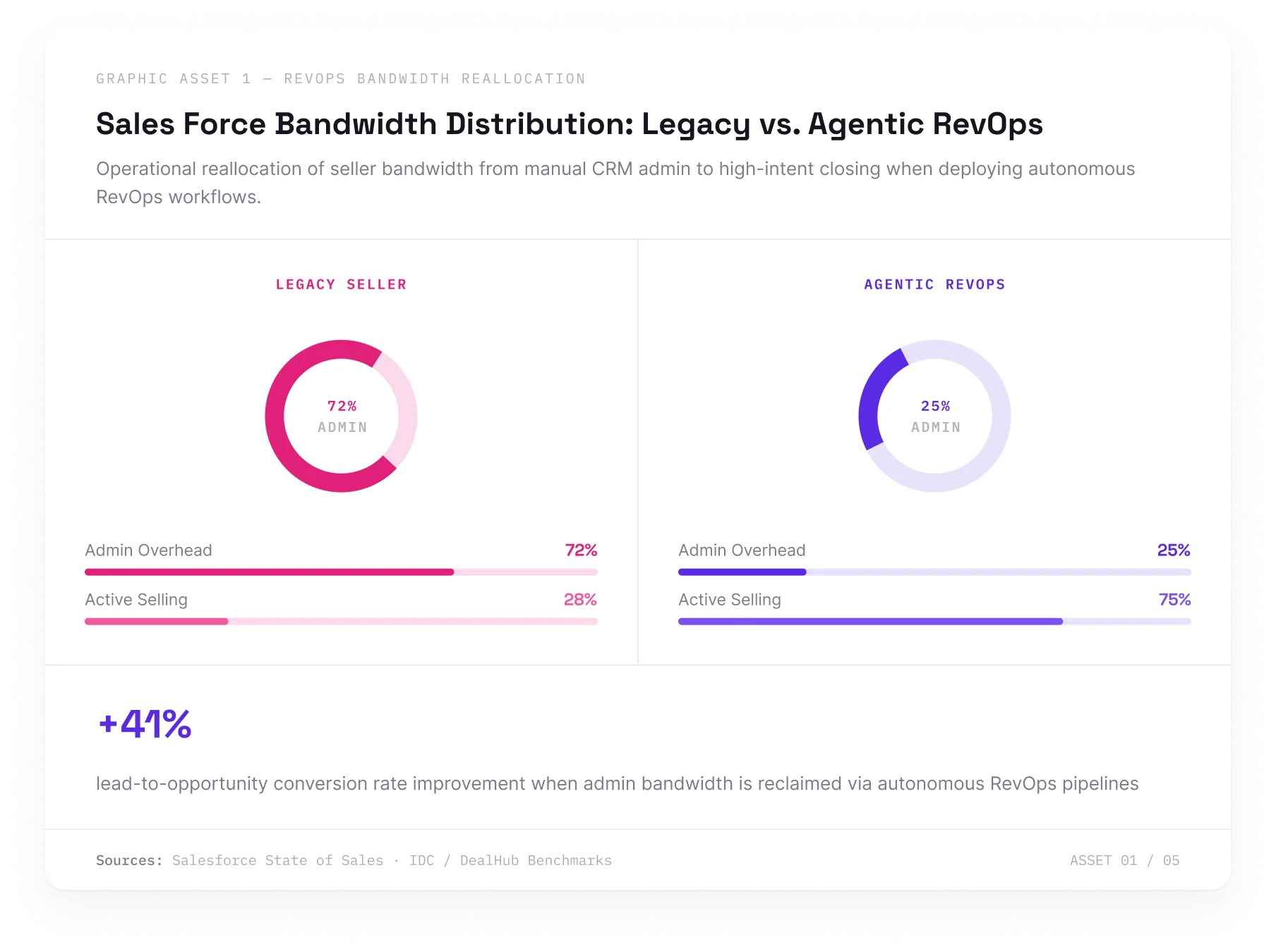
According to global workforce tracking in the Salesforce State of Sales Report, sales reps burn 72% of their working hours on administrative, non-selling activities, leaving a mere 28% of their weekly bandwidth for active customer engagement.
By deploying autonomous RevOps agents, SaaS platforms replace manual data entry with self-executing workflows. An agentic lead-to-cash pipeline independently monitors incoming prospect signals, cross-references multi-source firmographic APIs, enriches account profiles, and evaluates seller bandwidth to route qualified opportunities instantly.
The measurable impact of reclaiming this administrative bandwidth is illustrated in the operational shift below:
Proactive Customer Success: Defending NRR with Continuous Telemetry
While RevOps accelerates top-line acquisition, Customer Success determines long-term enterprise valuation through Net Revenue Retention (NRR). Historically, Customer Success Managers (CSMs) have operated reactively—noticing usage slumps, seat abandonment, or negative user sentiment only during 30-day pre-renewal account reviews, when customer churn is already inevitable.
Agentic AI transforms Customer Success from a reactive helpdesk into a proactive, continuous retention flywheel:
- Real-Time Telemetry Auditing: Multi-agent frameworks continuously monitor product usage, API call volumes, database query frequencies, and feature adoption metrics 24/7.
- Autonomous Playbook Execution: When an account shows a 15% drop in weekly active users or a key executive seat goes inactive, the CS agent autonomously executes targeted re-engagement workflows—provisioning custom video walkthroughs, sending specialized documentation, or surfacing a pre-drafted recovery strategy to the account manager.
- Predictive Renewal Scoring: Rather than relying on subjective CSM health scores, autonomous agents evaluate historical usage patterns to project renewal probability with high precision, allowing human teams to focus 100% of their bandwidth on high-risk, high-value enterprise contracts.
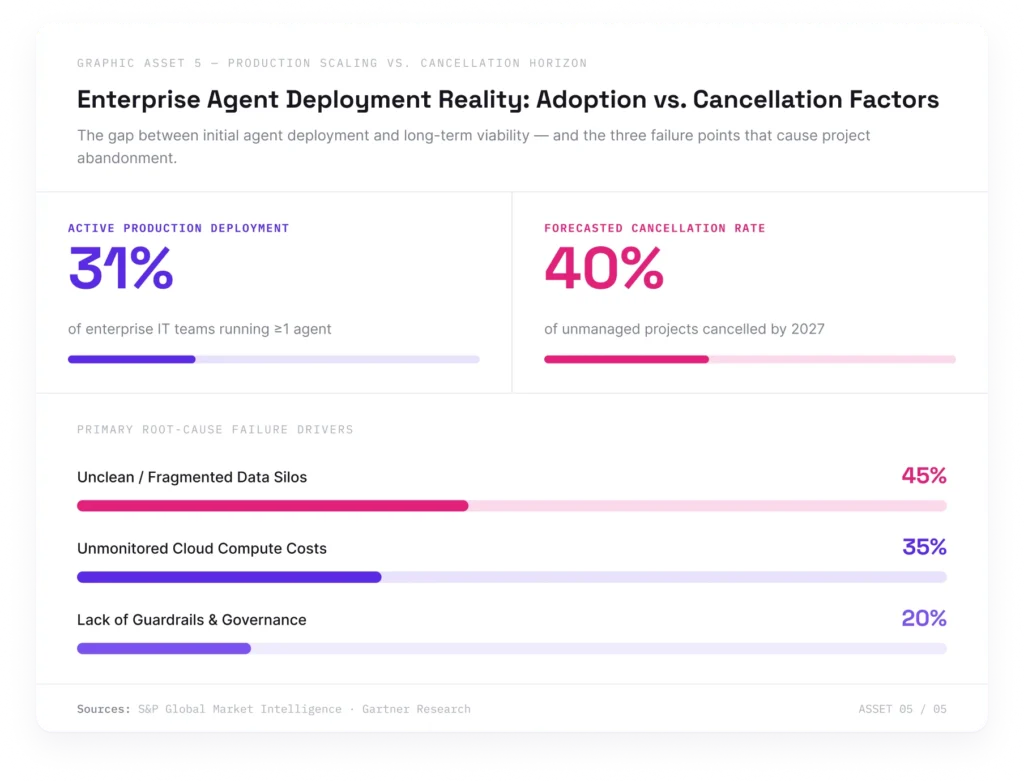
The structural difference between reactive account monitoring and proactive agentic telemetry is captured in the customer retention trajectory below:
Technical Onboarding: Compressing Time-to-Value (TTV)
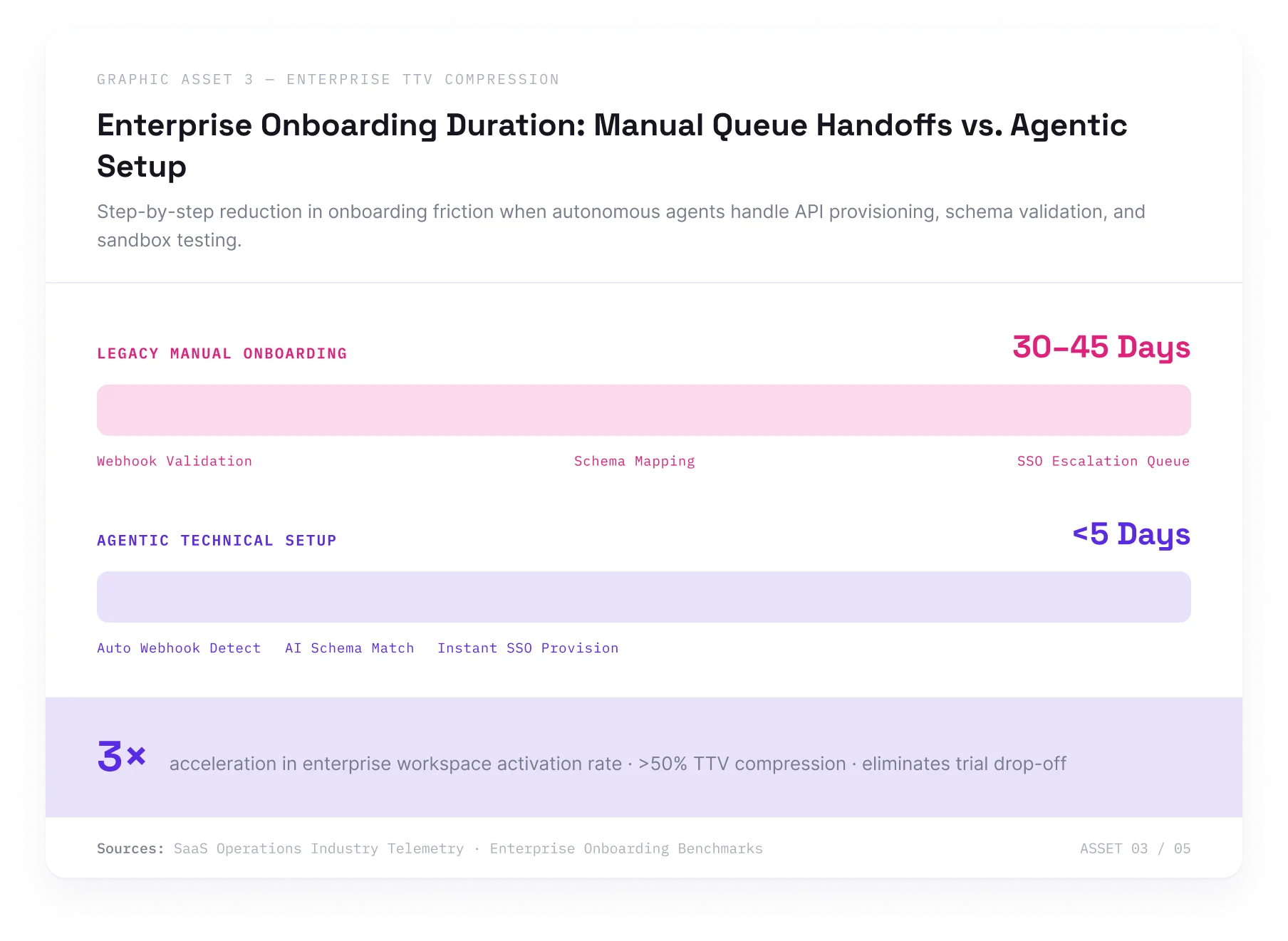
A primary driver of early churn in enterprise B2B SaaS is onboarding friction. When new customers face complex technical setup requirements—such as configuring SSO integrations, mapping database schemas, establishing webhooks, and provisioning API keys—the duration between contract signing and initial product utility stretches from days to months.
Every day spent in manual onboarding increases the probability of trial drop-off and contract cancellation.
Technical onboarding agents act as autonomous setup engineers. When a new customer workspace is provisioned, the onboarding agent autonomously validates incoming webhook payloads, detects database schema mismatches, tests sandbox API endpoints, and guides customer IT administrators through setup anomalies in real time.
The Collapse of Per-Seat Licensing: Shifting to Outcome-Based Unit Economics
As autonomous agents assume operational workloads across RevOps, Customer Success, and onboarding, the fundamental pricing architecture of B2B SaaS is undergoing a permanent transformation.
For two decades, SaaS companies monetized through per-seat licensing. However, as AI agents complete tasks directly, customers no longer need to purchase additional software seats to drive higher operational output. Selling per-seat access to an application that requires fewer human users creates an existential revenue paradox.
According to market research by Gartner, 40% of enterprise software applications will embed task-specific AI agents by the end of 2026, up from less than 5% in 2025. This rapid transition is forcing SaaS platforms to pivot toward Outcome-Based and Usage-Based Pricing Models.
The market acceleration of enterprise agent adoption and its direct inverse relationship with cost-to-serve is mapped below:
Surfacing the Friction: Why 40% of Internal Agentic Projects Fail
While the economic rationale for Agentic AI in SaaS operations is compelling, implementing autonomous workflows introduces severe engineering, cost management, and data governance challenges.
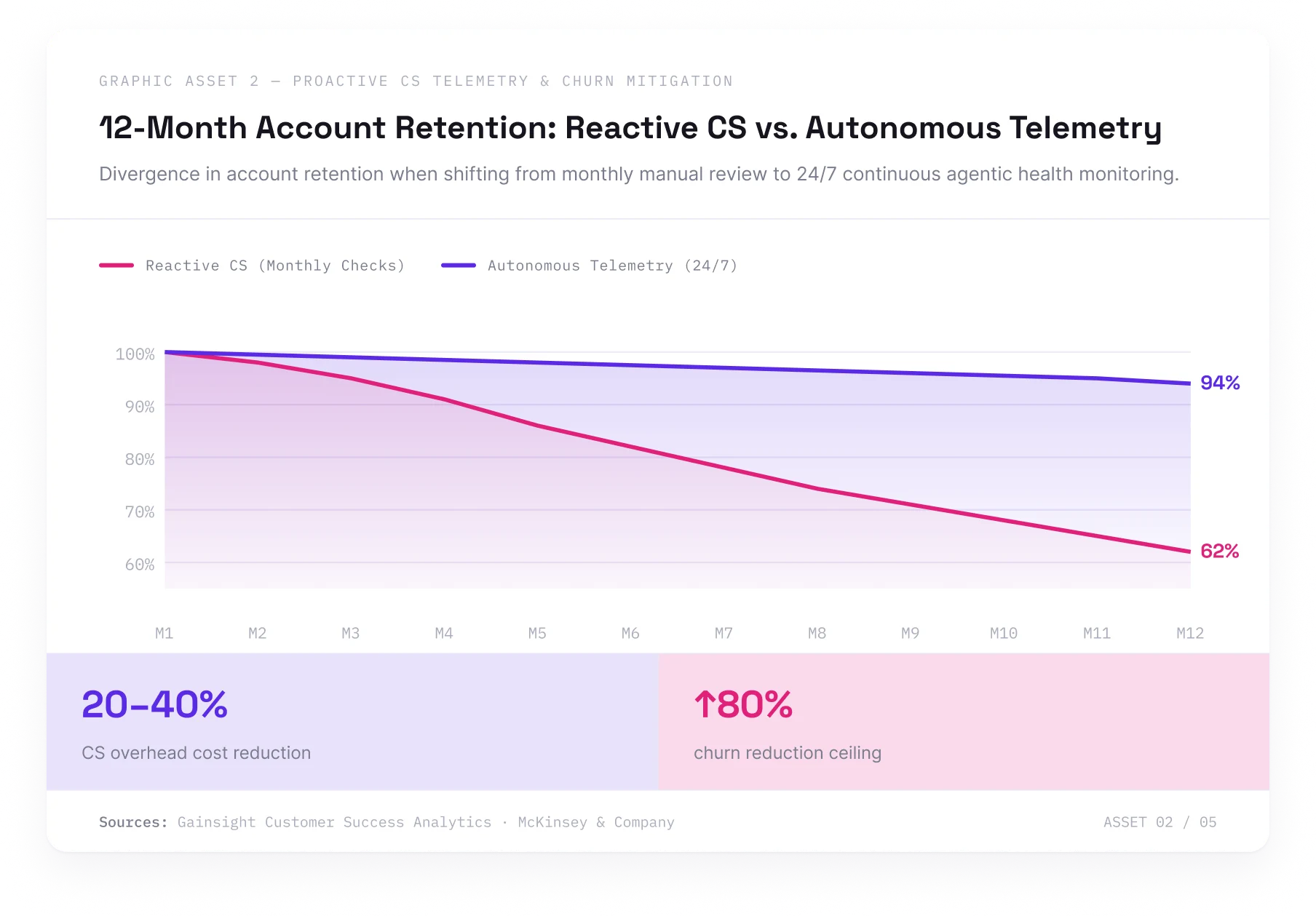
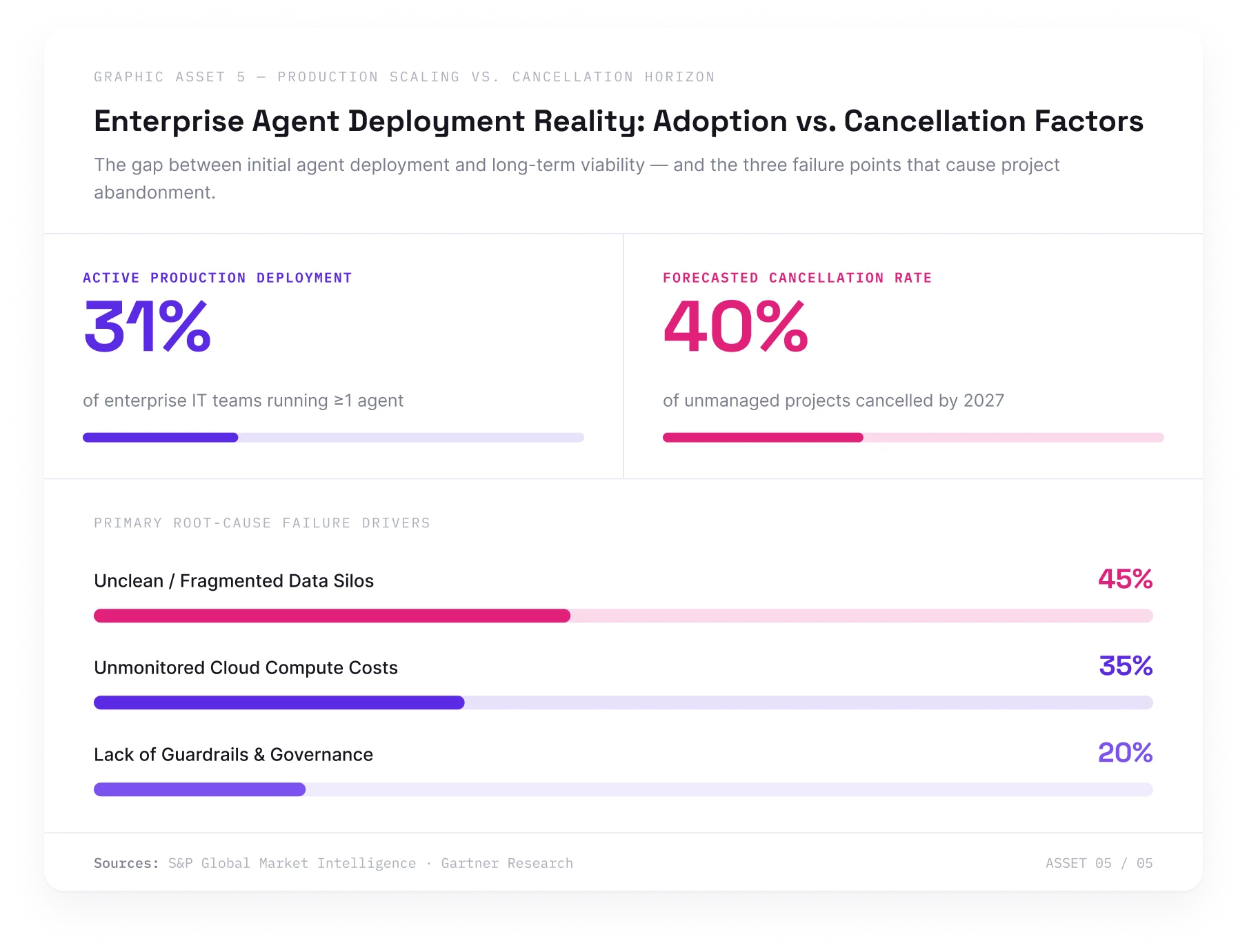
According to research from S&P Global Market Intelligence and Gartner, while 31% of enterprises now run at least one AI agent in production, over 40% of agentic AI initiatives are projected to be canceled by 2027 due to escalating compute costs, unmanaged data pipelines, and a lack of governance.
The structural failure points driving this cancellation horizon are quantified below:
As These Graphic illustrates, deploying goal-directed agents without structured data foundations and strict governance leads to rapid failure. The primary failure drivers include:
- Data Silos & Unclean Schema (45% of failures): An autonomous agent is only as reliable as the underlying data layer it queries. Fragmented CRM records, unindexed customer telemetry, and stale API documentation cause agents to execute flawed business logic.
- Unmonitored Agent Sprawl & Cost Escalation (35% of failures): Deploying agents without strict permissioning sandboxes, API rate limits, and continuous FinOps auditing leads to runaway cloud compute spend that destroys the very margins agents were meant to protect.
- Lack of Human-in-the-Loop Safeguards (20% of failures): Failing to define clear boundary ratios—delegating high-volume tactical execution to agents while reserving critical edge-case decisions for human approval—results in customer-facing errors that damage brand trust..
Scaling Autonomous SaaS Operations with IMS Nucleii
Overcoming these operational bottlenecks and building resilient, production-grade agentic workflows demands a specialized engineering and value partner. This is the exact capability delivered by IMS Nucleii.
IMS Nucleii acts as a full-stack digital infrastructure and value architect, helping growing B2B SaaS platforms and enterprise operators design, deploy, and govern intelligent automation frameworks that optimize unit economics:
- Custom Agentic Workflow Orchestration: We design and integrate multi-agent frameworks tailored to your specific GTM, Customer Success, and onboarding pipelines—connecting disparate APIs, cleaning data layers, and automating complex business logic without disrupting your core platform architecture.
- Data Pipeline Readiness & FinOps Governance: We build secure, permissioned data pipelines and real-time cloud governance guardrails that eliminate agent compute waste, enforce strict data privacy parameters, and maintain 100% audit-ready logs.
- Elite Managed Helpdesk & Infrastructure Operations (L1–L3): We manage your daily technical support, API monitoring, and system maintenance under fixed-cost SLAs, clearing helpdesk backlogs and allowing your internal engineering teams to focus on core product innovation.
Stop letting operational administrative burdens compress your gross margins. Connect with our principal automation architects at [email protected] to schedule a SaaS Operations & Agentic Readiness Audit today.
Key Takeaways
- Eliminating Admin Tax: Sales reps spend 72% of their bandwidth on non-selling admin tasks; agentic RevOps workflows automate lead enrichment and deal routing to boost conversions by 41% (Salesforce / IDC).
- Proactive NRR Defense: Autonomous Customer Success agents monitor 24/7 product telemetry, cutting support costs by 20% to 40% and preventing account churn by up to 80% (Gainsight / McKinsey).
- The 2026 Agent Surge: Gartner forecasts that 40% of enterprise software applications will feature task-specific AI agents by end of 2026, driving a fundamental shift toward outcome-based SaaS pricing models.
- Governance Mandate: Over 40% of unmanaged agentic AI projects risk cancellation by 2027 due to data pipeline flaws and compute waste, making structured governance, permissioned data layers, and human-in-the-loop controls mandatory.
Frequently Asked Questions (FAQ)
How does Agentic AI differ from traditional SaaS automation tools like Zapier or basic CRM rules?
Traditional automation tools rely on static, linear “if-this-then-that” rules that break whenever data formats or workflow conditions shift. Agentic AI operates as a cognitive, goal-directed system—evaluating objectives, reasoning across unstructured data, making API calls autonomously, and handling complex workflow exceptions without crashing.
Why is seat-based SaaS pricing declining in the era of Agentic AI?
Per-seat pricing monetizes human software users. Because Agentic AI completes tasks directly, customers achieve higher operational output with fewer human seats. SaaS companies are shifting to outcome-based pricing (charging per task completed or per issue resolved) to align revenue with delivered business value and protect gross margins.
How does IMS Nucleii ensure custom AI agents do not execute unauthorized decisions?
We build strict “Governance-as-Code” architectures featuring permissioned API sandboxes, prompt data loss prevention (DLP), real-time audit logging, and human-in-the-loop validation checkpoints for high-risk or edge-case transactions.
Sources and Citations
- Salesforce Research: Access data on sales rep bandwidth allocation in the Salesforce State of Sales Comprehensive Global Report.
- Gartner Technology Forecasts: Review enterprise application projections via Gartner Predicts: 40% of Enterprise Apps Will Feature Task-Specific AI Agents by 2026.
- S&P Global Market Intelligence: Examine enterprise deployment trends in the S&P Global Voice of the Enterprise: AI & Machine Learning Survey.
- IMS Nucleii Operations Portal: Explore enterprise automation architectures at the IMS Nucleii Enterprise IT Automation & Managed Services Hub.