
An executive evaluation of collapsed cloud stacks, pay-per-token procurement, and non-deterministic FinOps governance. Discover how enterprise technology leaders modernize cloud infrastructure to accommodate autonomous agentic execution.
For Chief Technology Officers, Chief Information Officers, and enterprise platform architects, cloud infrastructure management has entered a period of structural disruption.
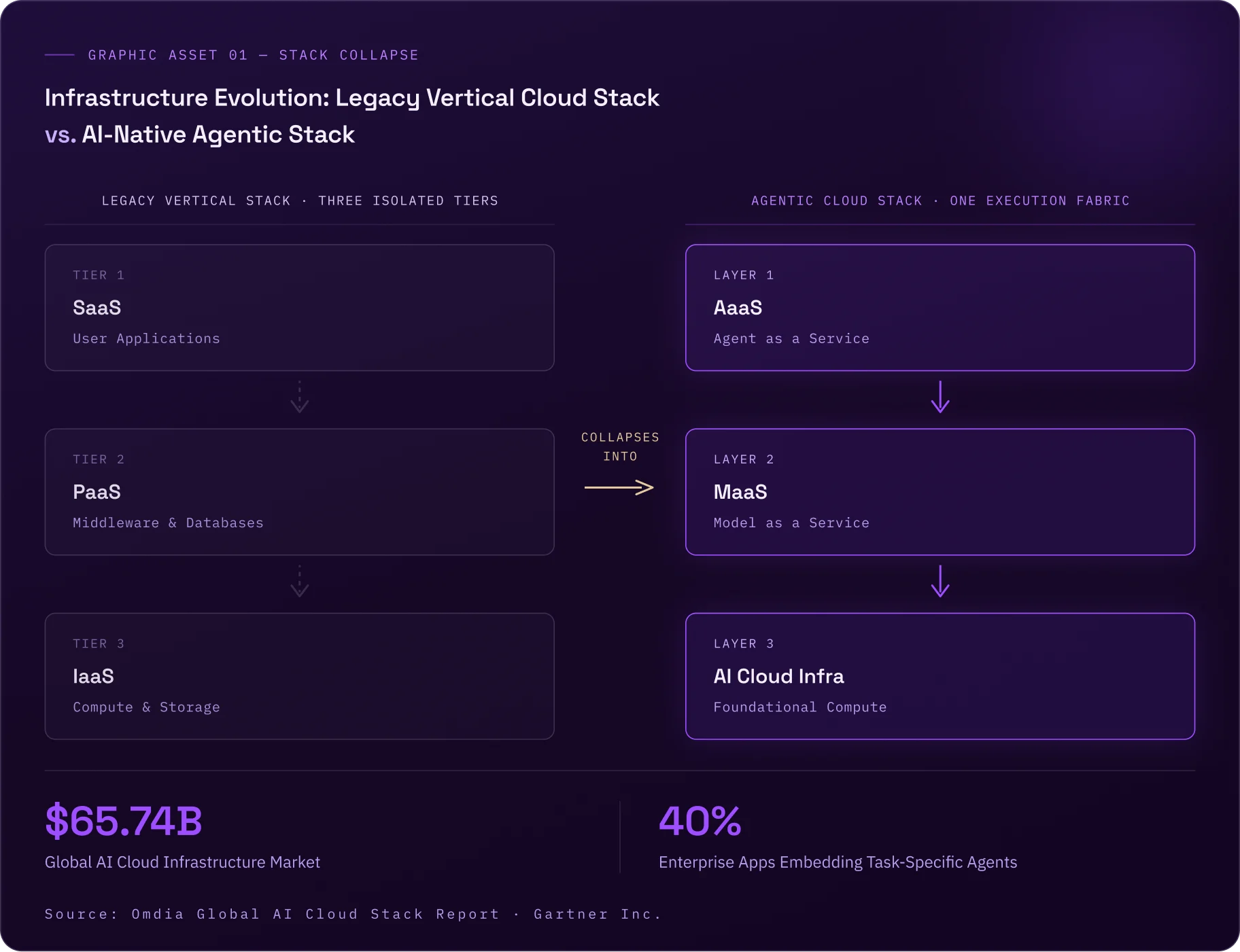
For nearly two decades, enterprise cloud strategy operated on a rigid, three-tier model: Infrastructure-as-a-Service (IaaS) provided foundational compute and storage, Platform-as-a-Service (PaaS) delivered application frameworks and middleware, and Software-as-a-Service (SaaS) delivered user-facing software.
In 2026, that vertical stack is collapsing.
Driven by the rapid rise of Agentic AI systems capable of autonomous planning, multi-step tool usage, and self-correcting workflow execution the boundaries separating IaaS, PaaS, and SaaS are dissolving. When a single model API call can query a database, trigger microservices, run security checks, and transform data autonomously, software layers cease to function as standalone products.
To maintain operational control and prevent severe budget overruns, technology leaders must re-architect their cloud environments around collapsed execution fabrics and transition toward Agentic FinOps.
The Structural Collapse of the Vertical Cloud Stack
The primary catalyst behind this architectural transformation is the evolution of Large Language Models (LLMs) from passive text generators into autonomous execution agents.
According to research from Omdia, traditional vertical cloud architectures are breaking down under the weight of AI-native demands. Rather than navigating discrete software tiers, enterprises are adopting an integrated three-layer architecture: AI Cloud Infrastructure (AI Cloud Infra), Model-as-a-Service (MaaS), and Agent-as-a-Service (AaaS).
In an agent-centric paradigm, an enterprise agent does not simply sit on top of SaaS software; it operates as an autonomous virtual worker that interacts directly with underlying APIs across the entire infrastructure. As a result, traditional middleware is absorbed directly into the model’s execution loop, rendering static subscription tiers redundant.
Procurement Pivot: From Pay-Per-Layer to Pay-Per-Token & Outcome Billing
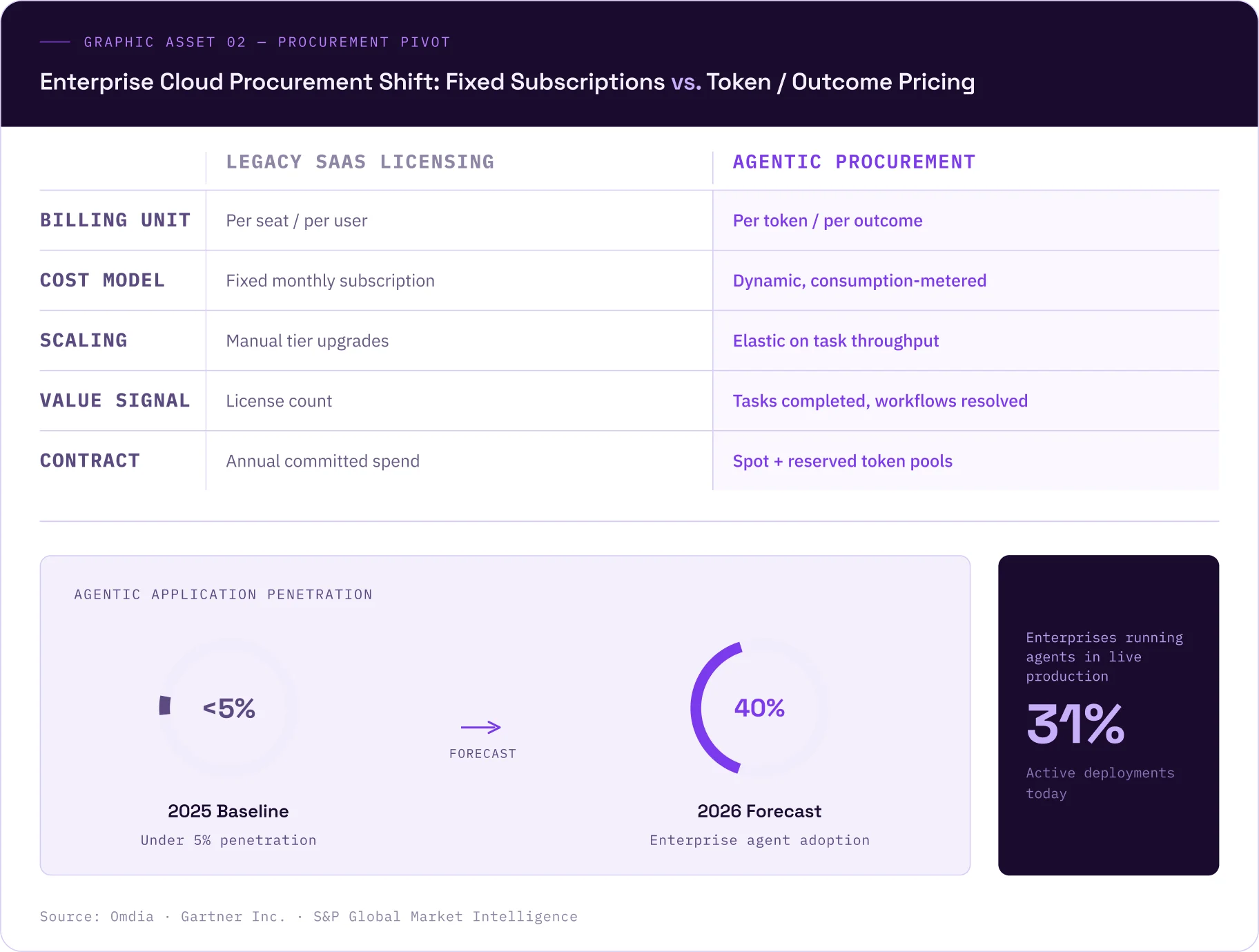
As cloud architectures collapse, enterprise procurement logic is undergoing a parallel shift. Traditional cloud contracting relies on predictable, seat-based SaaS licenses and reserved IaaS instance capacity.
However, as autonomous agents perform complex, multi-step tasks independently, static seat licenses no longer reflect consumed value.
According to market research by Omdia and Gartner, enterprise billing is pivoting rapidly from a “pay-per-layer” model to a “pay-per-token” and outcome-based approach. Tokens have become the fundamental accounting unit for enterprise workloads, treating AI models as a dynamic utility layer rather than a fixed software license.
With Gartner forecasting that 40% of enterprise software applications will feature task-specific AI agents by the end of 2026 (up from under 5% in 2025), cloud buyers are demanding pricing models tied directly to automated business throughput—such as cost per resolved ticket, cost per processed invoice, or cost per executed workflow.
The FinOps Crisis: Managing Non-Deterministic Compute Waste
While the operational speed of Agentic AI is undeniable, its non-deterministic nature introduces severe financial governance risks for FinOps teams.
Unlike traditional software code which follows predictable, deterministic execution paths autonomous agents employ variable reasoning loops, dynamically calling third-party tools, retrying failed API requests, and generating dynamic context windows. Unmonitored, a single looping agent can consume millions of tokens in minutes, creating unexpected spikes in cloud infrastructure bills.
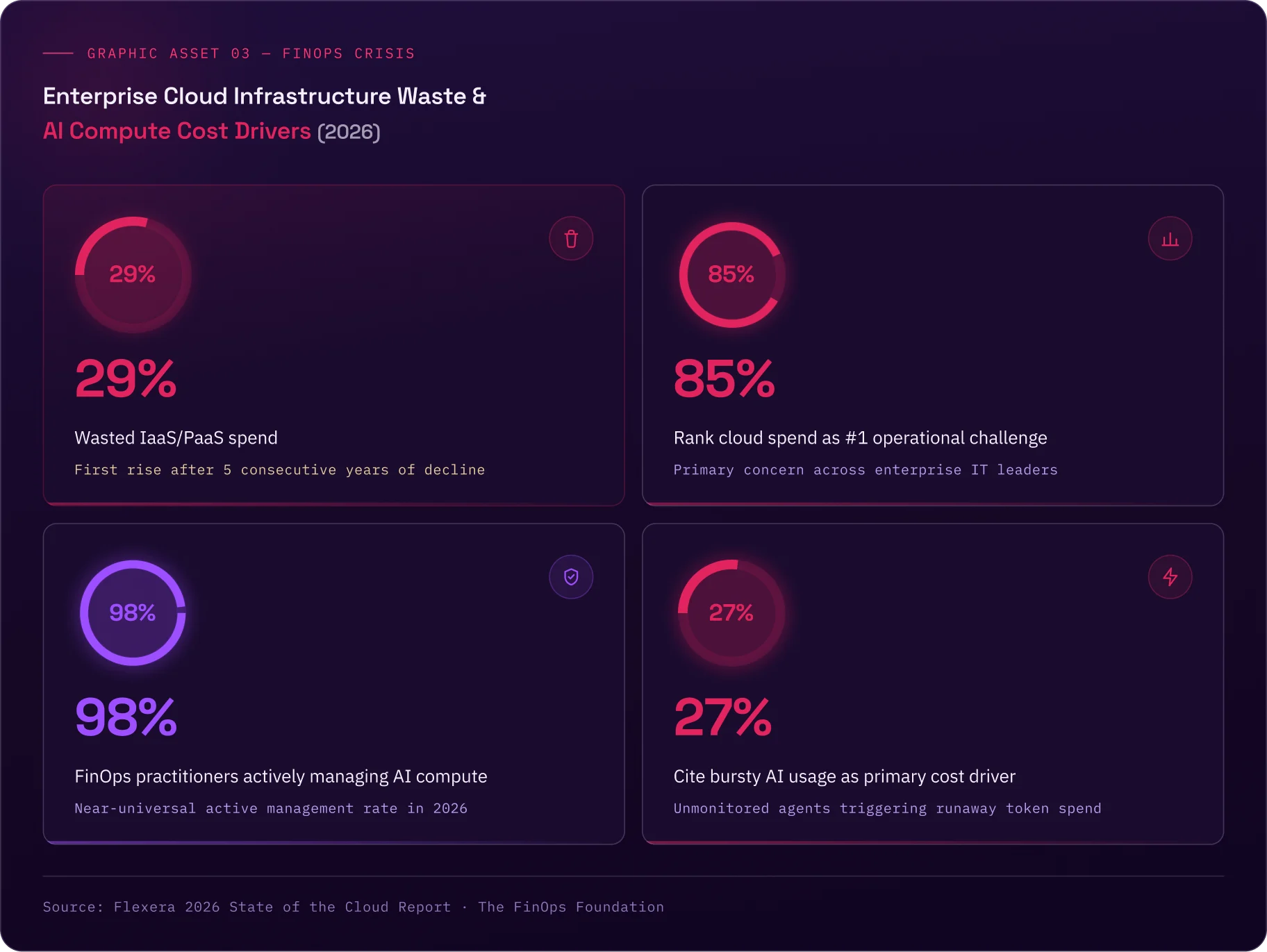
Data from the Flexera 2026 State of the Cloud Report highlights a alarming reversal in enterprise cloud efficiency:
- Wasted Cloud Infrastructure Spend: Wasted IaaS and PaaS spend has risen to 29%, marking the first increase in wasted cloud spend after five consecutive years of decline.
- Managing Cloud Spend as the Top Priority: 85% of IT and cloud practitioners rank managing cloud spend as their primary operational challenge, outpacing security concerns.
- Bursty AI Usage as a Cost Driver: Unpredictable, bursty AI workload consumption is cited by 27% of organizations as the leading cause of runaway cloud costs.
Furthermore, research from the FinOps Foundation reveals that 98% of FinOps practitioners now actively manage AI compute spend. Without strict real-time rate limits, prompt caching, and agentic governance guardrails, organizations risk having their cloud cost savings completely erased by unmanaged compute waste.
Navigating the Agentic Cloud with IMS Nucleii
Building a scalable, cost-controlled agentic cloud architecture requires a specialized digital infrastructure and FinOps engineering partner. This is the exact operational capability delivered by IMS Nucleii.
IMS Nucleii functions as an enterprise value architect and managed IT technology partner, helping organizations modernize their cloud environments, optimize compute consumption, and implement strict governance over autonomous workflows:
- Agentic Cloud Architecture Engineering: We re-architect legacy multi-tier IaaS/PaaS/SaaS footprints into optimized Agentic Cloud stacks (AI Infra, MaaS, AaaS), enabling seamless multi-agent orchestration without infrastructure bottlenecks.
- Real-Time FinOps & AI Cost Governance: We deploy automated rate-limiting, token-caching, and real-time observability guardrails that eliminate bursty compute waste, bringing wasted cloud spend well below industry averages.
- Enterprise Multi-Cloud Interoperability: We build secure API sandboxes and zero-trust execution runtimes that allow autonomous agents to operate safely across hybrid and multi-cloud environments.
- Managed IT & Infrastructure Operations (L1–L3): We manage your daily cloud operations, database health, and system monitoring under fixed SLAs, allowing internal engineering teams to focus on core product development.
Master your cloud economics in the age of autonomous AI. Connect with our principal cloud architects at [email protected] to schedule an Enterprise Cloud & FinOps Readiness Audit today.
Key Takeaways
- Stack Collapse: Vertical IaaS, PaaS, and SaaS layers are collapsing into a unified three-tier Agentic Cloud architecture (AI Infra, MaaS, AaaS) driven by autonomous model execution.
- Procurement Transformation: Cloud contracting is shifting from fixed seat licenses to pay-per-token and outcome-based pricing models.
- Rising Cloud Waste: Driven by unpredictable AI workloads, wasted cloud infrastructure spend has risen to 29%, with 85% of IT leaders naming cloud spend as their top challenge.
- FinOps Imperative: With 98% of FinOps teams now managing AI costs, organizations require real-time token caching and execution guardrails to prevent runaway compute spend.
Frequently Asked Questions (FAQ)
1.What is the difference between traditional cloud architecture and an Agentic Cloud architecture?
Traditional cloud architecture separates compute/storage (IaaS), developer middleware (PaaS), and end-user applications (SaaS) into distinct vertical layers. An Agentic Cloud architecture integrates these layers into a unified execution fabric (AI Infra, MaaS, AaaS) where autonomous AI agents invoke multi-layer functions directly via single model API calls.
2. Why is cloud waste increasing in 2026 despite mature FinOps practices?
According to Flexera, wasted cloud spend rose to 29% largely due to the rapid influx of unpredictable, bursty AI agent workloads. Non-deterministic AI reasoning loops spin up dynamic GPU and compute instances faster than traditional quarterly FinOps governance tools can track.
3. How does IMS Nucleii control runaway token and cloud compute costs?
IMS Nucleii integrates real-time FinOps observability tools, prompt-caching layers, strict API rate-limiting sandboxes, and automated execution thresholds directly into your cloud infrastructure, preventing agents from entering infinite execution loops.
Sources and Citations
- Omdia Market Research: Review detailed architectural analysis in the Omdia Report: Global AI Cloud Stack 2026 – Rethinking Cloud in the Agentic AI Era.
- Flexera Research: Access infrastructure spend data in the Flexera 2026 State of the Cloud Report.
- Gartner Technology Insights: Examine enterprise application agent projections in Gartner Predicts 40% of Enterprise Apps Will Feature Task-Specific AI Agents by 2026.
- FinOps Foundation: Review AI cost management benchmarks in the State of FinOps 2026 Survey.
- IMS Nucleii Operations Hub: Explore enterprise cloud automation solutions at the IMS Nucleii Enterprise IT Automation & Cloud Services Portal.