
An executive evaluation of L2 recruiting bottlenecks, out of hours escalation noise, and delivery capacity constraints. Discover how leading UK Managed Service Providers deploy co managed engineering squads to protect senior utilization and expand contract gross margins.
For Chief Executive Officers, COOs, and operational leaders across the UK Managed Service Provider (MSP) sector, top line revenue growth is no longer the primary indicator of business health.
Across mid market MSPs, a clear operational paradox has emerged: client portfolios are expanding, new service contracts are being signed, yet net profitability percentage is steadily declining.
This operational plateau the Mid Market MSP Growth Ceiling is rarely caused by lost sales proposals or poor customer acquisition. Instead, margin erosion occurs silently inside contracts already won. As client cloud estates expand, static pricing models stay fixed while the unmonitored cost to serve explodes.
To break through this growth ceiling, executive leadership must identify and plug the three silent profit leaks destroying contract gross margins.
Profit Leak 1: The L2 Vacuum and the Blended Rate Trap
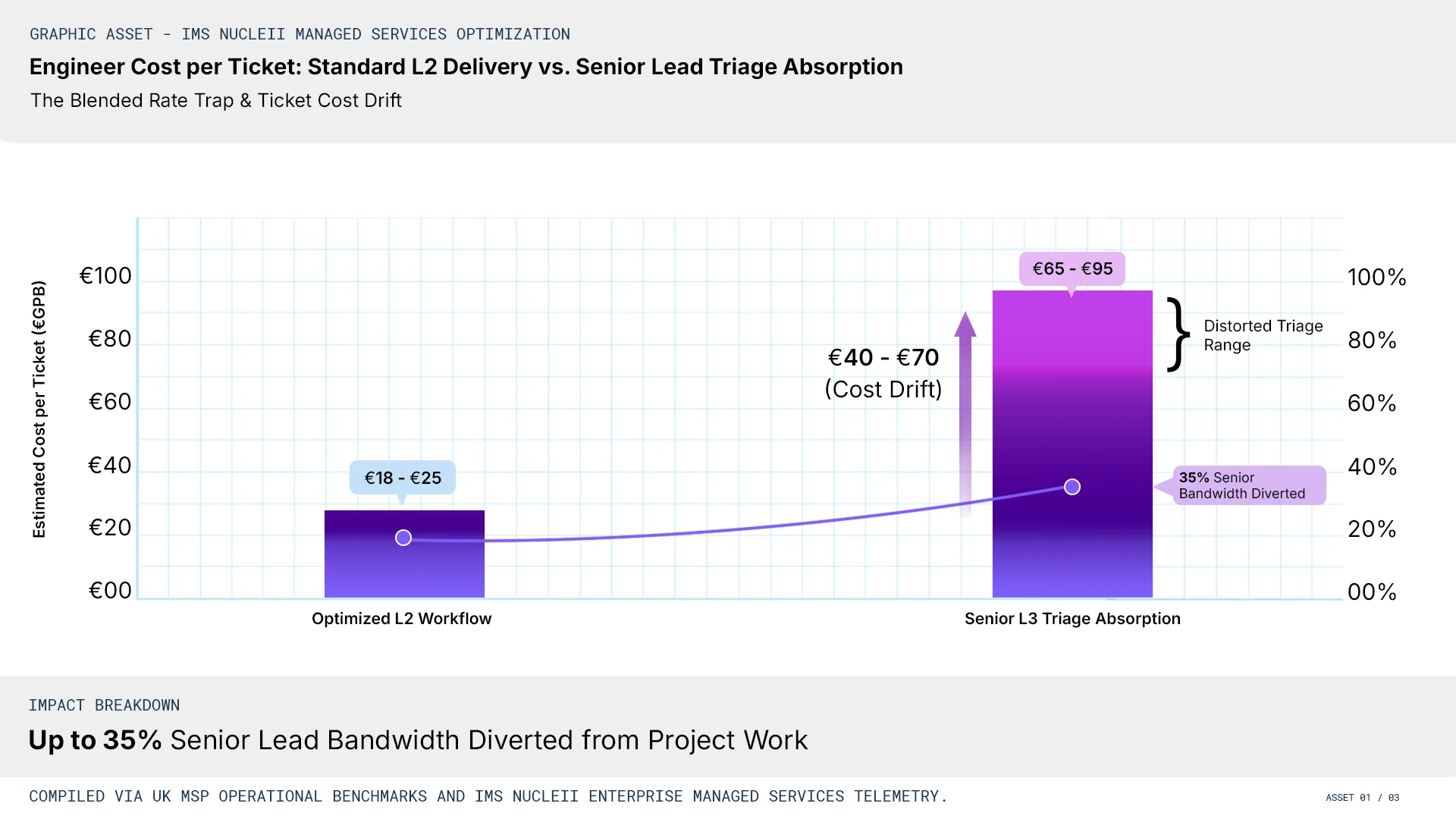
The primary operational trigger of margin compression begins in the helpdesk triage layer. The UK technology market faces a persistent shortage of qualified Level 2 (L2) support engineers. When L2 vacancies remain unfilled for weeks or months, ticket queues back up and service level agreement (SLA) breaches loom.
To maintain delivery quality, MSP leadership is forced to route routine L2 ticket triage and escalation handling to senior L3 architects and technical leads.
This dynamic creates the Blended Rate Trap. When an engineer earning an $L3$ salary spends 30% to 40% of their day resolving routine password resets, basic network troubleshooting, or user provisioning, the average engineer cost per ticket spikes dramatically. What appears to be an internal staffing compromise silently destroys the gross margin of the underlying managed service contract.
Profit Leak 2: Out of Hours (OOH) Burnout and Unmonitored Cost to Serve Drift
The second profit leak stems from the operational burden of 24/7 out of hours coverage. Enterprise clients increasingly demand round the clock infrastructure monitoring and immediate incident response.
In a traditional onshore payroll model, 24/7 coverage requires placing core senior architects on overnight escalation rotas.
- The Attrition Cascade: Forcing high value senior engineers to handle low complexity overnight alerts causes severe operational fatigue and hidden attrition. Replacing a senior UK technical lead carries an average recruitment and onboarding cost exceeding £25,000, alongside months of lost institutional knowledge.
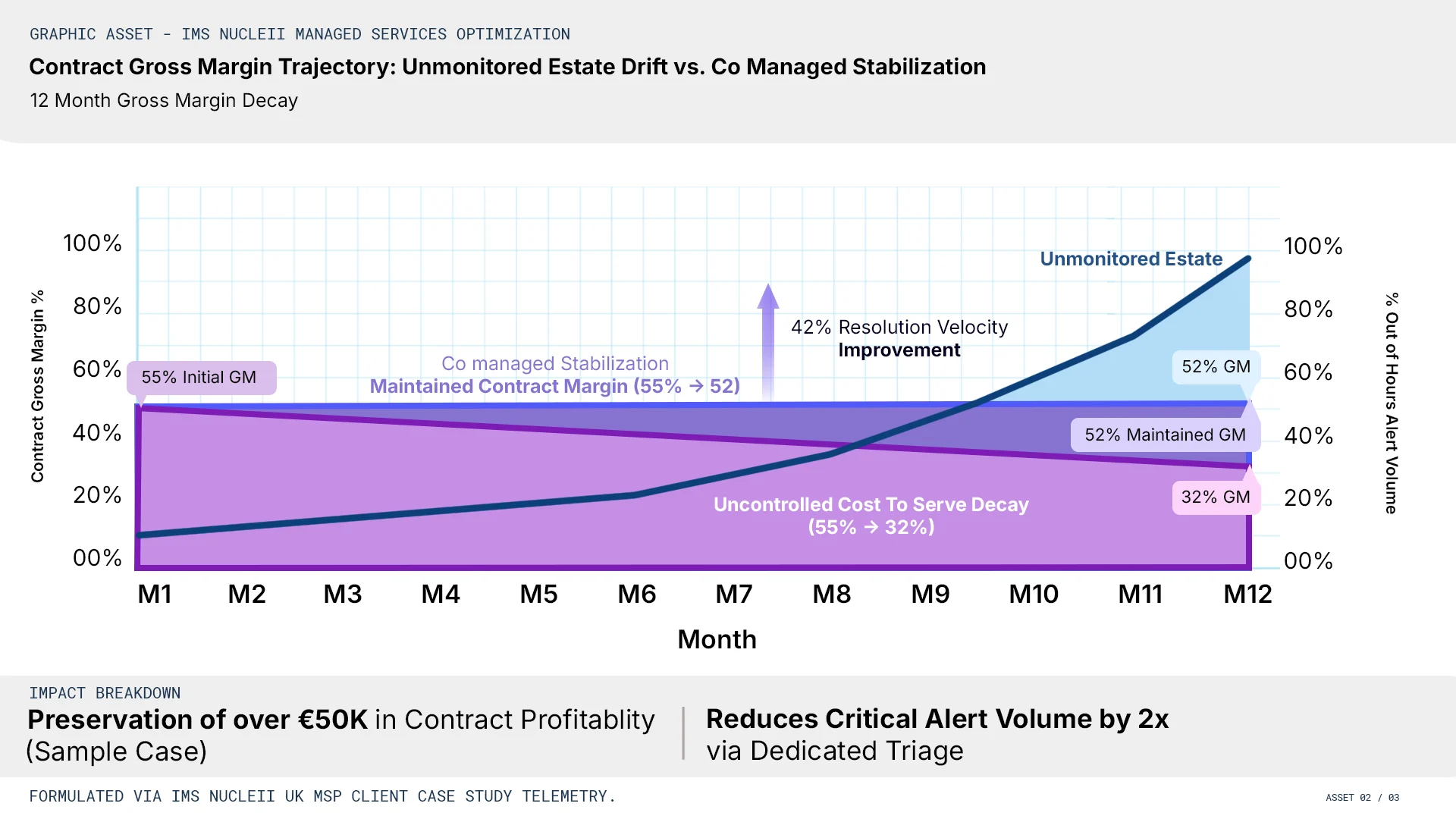
- Cost to Serve Drift: As client cloud infrastructures grow more complex, the volume of background alerts increases. Because client contracts are typically billed at static monthly rates, the hours required to maintain system stability expand unmonitored, compressing contract gross margins quarter after quarter.
By integrating dedicated co managed $L2/L3$ squads into existing helpdesk tooling, MSPs absorb out of hours escalation noise, insulate senior engineers, and stabilize the cost to serve.
Profit Leak 3: Bid Window Paralysis and the £600/Day Contractor Dilemma
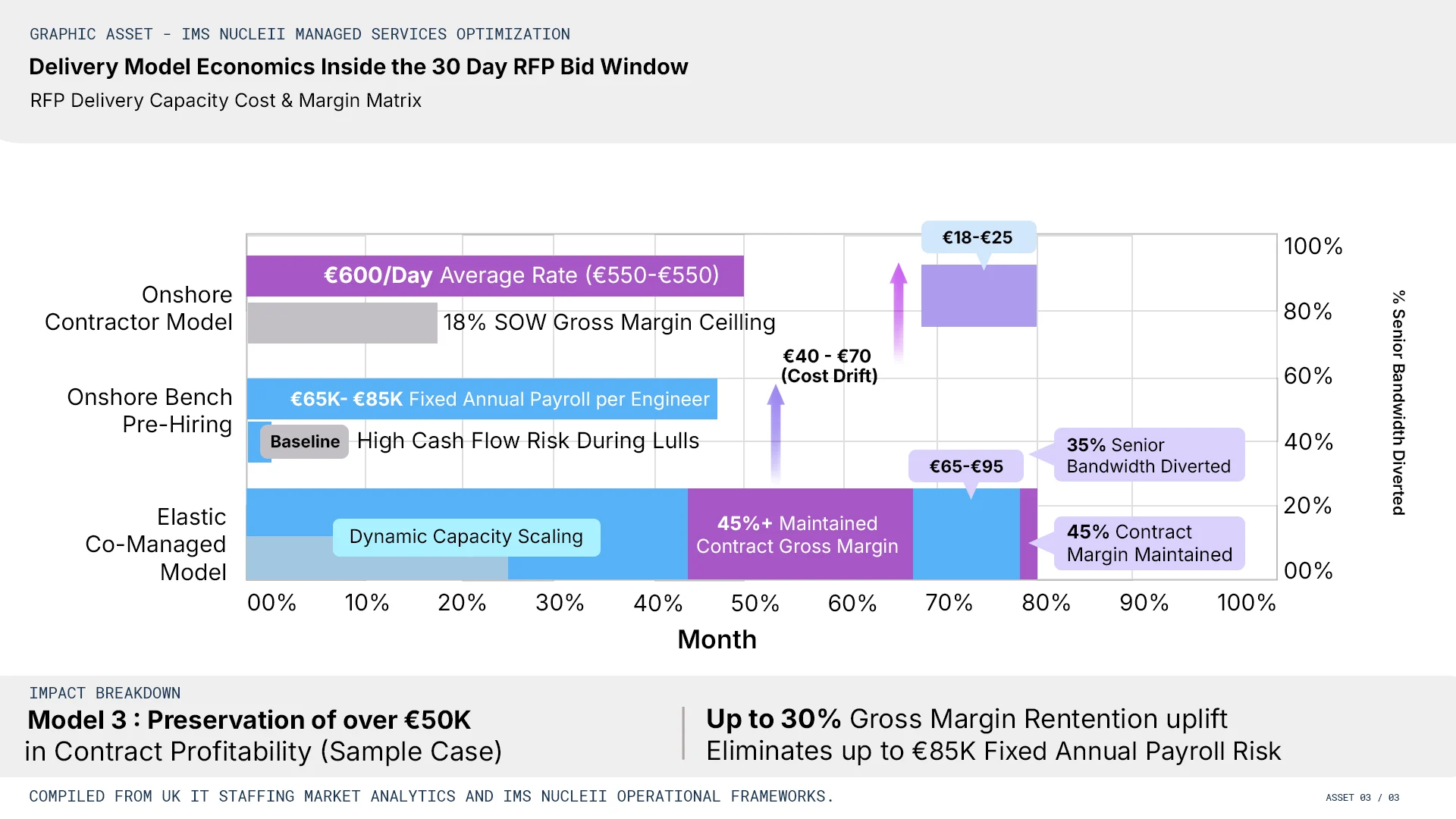
The final structural barrier limiting mid market MSP expansion is Bid Window Paralysis. When competing for £1M+ enterprise managed service contracts, the primary operational constraint is rarely sales capability it is delivery capacity confidence inside a tight 30 day RFP window.
MSP executive teams face two bad choices during large contract bids:
- The Contractor Margin Trap: Bidding on large contracts and relying on onshore contractors at £600+ per day destroys Statement of Work (SOW) gross margins before the contract even begins.
- The Bench Overhead Risk: Pre hiring an onshore engineering team to build delivery capacity creates massive fixed payroll overhead during pipeline lulls, draining cash flow.
To eliminate bid window paralysis, forward thinking MSPs deploy elastic, co managed delivery squads. These dedicated squads operate directly within the MSP’s branded PSA/RMM tools under the supervision of UK leads, providing instant delivery capacity without fixed payroll risk.
The Operational Fix: Co Managed Delivery with IMS Nucleii
Breaking through the mid market growth ceiling requires transitioning from fixed onshore payroll dependencies to a flexible, hybrid co managed delivery engine.
IMS Nucleii acts as a strategic co managed delivery partner for growing UK MSPs, embedding dedicated $L2/L3$ engineering squads directly into your existing tools, workflows, and ticketing environments.
- Triage & L2 Queue Stabilization: Our dedicated squads absorb routine ticket noise, triage escalations, and handle Level 2 issues, reducing overall issue resolution times by up to 42%.
- 24/7 Out of Hours Coverage: We provide round the clock infrastructure monitoring and incident management, insulating your senior UK leads from overnight rotas and boosting overall system uptime by 28%.
- Elastic Capacity for Enterprise RFPs: Plug on demand engineering capacity directly under your UK architects during 30 day bid windows, enabling you to bid on and win £1M+ contracts without carrying expensive bench overhead.
Stop letting hidden delivery friction erode your contract profitability. Protect your gross margins and scale your delivery capacity. Contact us to get a comprehensive overview.
Key Takeaways
- Eliminate the L2 Vacuum: Routing routine triage to senior architects spikes the engineer cost per ticket and compresses contract gross margins.
- Protect Senior Utilization: Offloading overnight escalations and 24/7 rotas cuts resolution times by 42% and prevents senior lead attrition.
- Overcome Bid Window Paralysis: Elastic co managed squads eliminate the need for £600/day contractors, enabling MSPs to bid confidently on large enterprise RFPs.
- Stabilize Cost to Serve: Co managed models preserve contract gross margins above 50% even as client cloud estates expand.
Frequently Asked Questions (FAQ)
How does acomanaged model differ from traditional IT outsourcing?
Traditional outsourcing replaces internal staff with external third party teams that operate in separate silos. A co managed model embeds dedicated $L2/L3$ engineers directly into your existing helpdesk tools, PSA/RMM platforms, and workflows. Your senior UK leads retain complete operational control while leveraging our elastic squad for execution.
How does IMS Nucleii ensure brand consistency and service quality?
All client interactions, ticket updates, and documentation are executed within your branded PSA system following your established Standard Operating Procedures (SOPs). To end clients, our engineers operate seamlessly as an extension of your internal UK technical team.
Can comanaged capacity be scaled up or down based on contract wins?
Yes. IMS Nucleii provides elastic capacity designed specifically to solve the 30 day RFP bid window constraint. You can rapidly scale dedicated squad capacity up as new enterprise contracts are won, eliminating the cash flow risk of carrying an idle onshore bench during pipeline lulls.
Sources and Citations
- IMS Nucleii Enterprise Case Studies: Review operational data on co managed delivery performance in the IMS Nucleii Co Managed Delivery Analysis Directory.
- UK IT Managed Services Benchmarks: Examine industry research on UK MSP margin trends and staffing metrics via IMS Nucleii IT Infrastructure Insights.