An executive evaluation of consumption volatility, architectural cost guardrails, and outcome-based tokenomics. Discover how technology leaders master cloud cost optimization and secure AI infrastructure cost sovereignty.
For Chief Information Officers (CIOs), Chief Technology Officers (CTOs), and enterprise finance leaders, scaling generative AI and autonomous agentic systems has introduced an unprecedented operational dilemma.
While business units rapidly deploy autonomous agents to drive productivity, financial accountability remains strictly on the CIO’s desk.
In an AI cloud ecosystem, traditional static IT budgeting models fail. Unlike legacy virtual machines billed at predictable hourly rates, dynamic AI workloads consume compute based on non-deterministic token volumes, dynamic context windows, and multi-step reasoning loops.
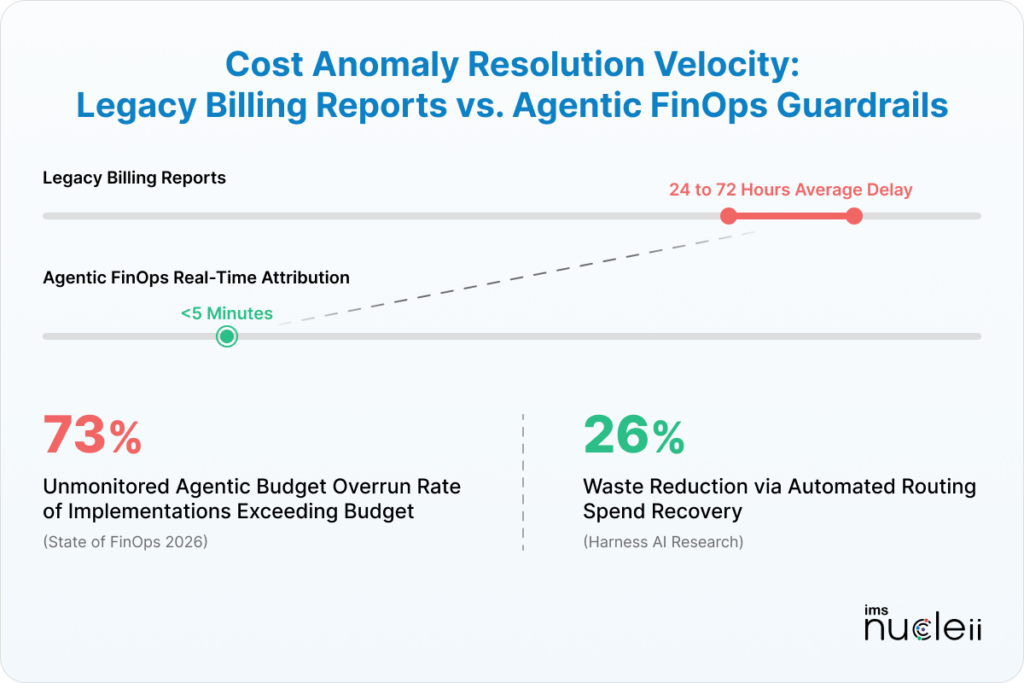
According to the State of FinOps 2026 Report, 98% of enterprise FinOps practices now manage AI spend, up from 31% two years prior. However, research from Harness reveals that 73% of enterprise AI implementations exceed their allocated budget, with 26% of total enterprise AI spend wasted due to unmonitored execution loops and fragmented cost ownership.
To achieve true cloud cost optimization without stalling innovation, enterprise leaders must transition from reactive dashboard monitoring to architectural governance and outcome-based unit economics.
Architectural Guardrails: Hardening the AI Cloud Against Volatility
The primary driver of surprise six-figure GPU and model bills is the absence of real-time execution controls inside the application layer. When autonomous agents attempt complex tasks, unexpected errors can trigger recursive retry loops, burning millions of tokens in minutes.
Data from IDC indicates that Global 1000 organizations face up to a 30% rise in underestimated AI infrastructure costs when using traditional compute forecasting tools for agentic workflows. Standard cost management tools report spending after it occurs, leaving technology leaders with zero real-time intervention capability.
Reclaiming AI infrastructure cost sovereignty requires embedding architectural guardrails directly into the ai cloud runtime:
Real-Time Token Rate Limiting: Setting automated, hard caps on token consumption per user session, API key, and business unit to stop runaway loops instantly.
Automated Model Routing: Dynamically directing low-complexity queries to smaller, open-weight models while reserving expensive frontier LLMs for high-reasoning tasks.
Semantic Prompt Caching: Caching frequently requested vector embeddings and prompt contexts at the gateway level, reducing redundant model inference calls by up to 40%.
Sub-Hour Cost-Spike Attribution: Implementing real-time telemetry that attributes cost spikes to specific microservices within minutes, rather than waiting days for cloud provider billing updates.
Elevating FinOps: Moving from Token Counting to Outcome-Based Unit Economics
While architectural guardrails stop budget overruns, long-term cloud cost optimization requires connecting infrastructure spend directly to business outcomes.
Tracking raw token consumption or GPU hours in isolation provides incomplete financial context. A $50,000 monthly inference bill is economically advantageous if it generates $500,000 in automated customer service value, but disastrous if it merely powers internal prompt experimentation.
Enterprise technology teams must establish AI tokenomics unit economics by converting raw infrastructure metrics into business KPIs:
- Cost-per-Inference (CPI): Calculating the blended infrastructure cost required to deliver a single model response across all supporting data pipelines.
- Cost-per-Resolved Task (CPRT): Measuring total compute, vector database, and API spending required for an autonomous agent to successfully complete a business transaction.
- Value-Tied Chargeback Models: Replacing generic IT overhead allocation with precise, usage-based chargebacks to individual business units, eliminating unassigned AI spend.
Aligning GPU cost management with unit economics gives CFOs and CIOs complete visibility into which ai workloads yield positive returns on investment.
Sustainable AI Cloud Governance: Balancing Innovation and Margin
The goal of cost management in the AI era is not to restrict engineering teams from leveraging advanced models, but to establish a predictable operational foundation for scaling.
Organizations that combine gateway-level guardrails with unit economics achieve continuous cost sovereignty. By eliminating token waste, optimizing model routing, and enforcing real-time accountability, enterprise technology teams deploy high-performing ai workloads while protecting corporate gross margins.
Securing AI Infrastructure Sovereignty with IMS Nucleii
Mastering cloud cost optimization across complex multi-cloud and AI infrastructure requires dedicated engineering capabilities. This is the exact operational baseline delivered by IMS Nucleii.
IMS Nucleii functions as an enterprise value architect and managed IT infrastructure partner, helping organizations modernize their cloud environments, optimize compute consumption, and enforce real-time financial governance over autonomous workflows:
- AI Cloud Architecture & FinOps Engineering: We re-architect unmonitored model deployments into high-efficiency ai cloud stacks, integrating automated model routing, semantic prompt caching, and zero-trust execution sandboxes.
- Real-Time Token Rate Limiting & Anomaly Detection: We deploy gateway-level governance tools that monitor inference streams in real time, detecting anomalies and cutting off runaway execution loops before they inflate monthly billing.
- Unit Economics & Chargeback Matrix Design: We map complex token spend directly to business KPIs (Cost-per-Inference, Cost-per-Resolved Task), providing clear financial visibility for C-suite leadership.
- Managed IT Infrastructure Operations (L1–L3): We manage your daily cloud operations, database health, and system monitoring under strict SLAs, allowing internal teams to focus on core product development.
Take control of your AI compute economics. Connect with our cloud architects at [email protected] or visit the IMS Nucleii AI Cloud Cost Governance Hub to schedule an AI Infrastructure Audit today.
Key Takeaways
Universal FinOps Mandate: 98% of enterprise FinOps teams now manage AI spend, driven by rapid adoption and high consumption volatility.
High Overrun Risk: 73% of enterprise AI implementations exceed their budget, with unmonitored execution loops driving 26% in wasted spend (Harness / State of FinOps 2026).
Architectural Control: Achieving AI infrastructure cost sovereignty requires gateway-level controls, including real-time token rate limiting, semantic prompt caching, and automated model routing.
Outcome-Based Economics: Leading technology organizations replace raw token counts with outcome metrics such as Cost-per-Resolved Task to evaluate true ROI.
Frequently Asked Questions (FAQ)
Why do traditional cloud cost management tools fail to control AI workload spend?
Traditional cloud cost tools monitor static server instances and storage volumes, reporting spend retroactively via daily or monthly billing files. AI workloads depend on non-deterministic token usage and multi-step agent reasoning loops that can consume tens of thousands of dollars in minutes, requiring real-time gateway-level intervention rather than passive dashboard reporting.
How does real-time token rate limiting prevent surprise cloud bills?
Real-time token rate limiting enforces hard programmatic caps on the number of tokens an individual agent, user, or microservice can consume within a given time window. If an agent enters an infinite retry loop, the gateway automatically terminates the session, preventing unchecked compute consumption.
What is the benefit of tracking Cost-per-Resolved Task instead of token volume?
Tracking raw tokens measures raw resource consumption without indicating business value. Measuring Cost-per-Resolved Task combines all underlying infrastructure, API, and compute costs required to complete a specific business workflow, allowing leadership to evaluate the exact return on investment for every deployed AI feature.
Sources and Citations
FinOps Foundation: Examine global enterprise AI spend benchmarks in the State of FinOps 2026 Report.
Harness Research: Review AI cost governance and waste metrics in the Harness 2026 State of AI in FinOps Report.
IDC FutureScape Briefings: Access forecasts on enterprise infrastructure spend in IDC Research: AI Infrastructure Cost Evolution.
Flexera Software: Review enterprise cloud optimisation data in the Flexera 2026 State of the Cloud Report.
IMS Nucleii Operations Portal: Explore enterprise AI cloud governance solutions at the IMS Nucleii AI Cloud Cost Governance Hub.