An executive guide to taming non-deterministic LLM inference costs, GPU over-provisioning, and multi-cloud sprawl. Discover how a modern cloud governance framework restores predictability to technology budgets.
For technology and finance leaders across the enterprise landscape, cloud financial management has entered a complex new phase. For nearly a decade, public cloud procurement followed a familiar trajectory: “lift-and-shift” migrations followed by multi-year optimization cycles designed to trade rigid CapEx for elastic OpEx.
After five consecutive years of steady progress in trimming infrastructure bloat, that downward cost curve has suddenly reversed.
The culprit is the explosive migration of generative AI (GenAI) models into live production. Unlike traditional cloud workloads with predictable server traffic, AI pipelines introduce non-deterministic, probabilistic compute patterns. Between unmonitored GPU cluster reservations, sprawling developer sandboxes, and uncapped API token usage, enterprise technology budgets are experiencing intense structural leakage. Achieving real cloud cost optimization now requires moving beyond basic dashboard tracking toward a proactive cloud governance framework.
1. The 29% Reversal: How AI Workloads Drive Infrastructure Waste
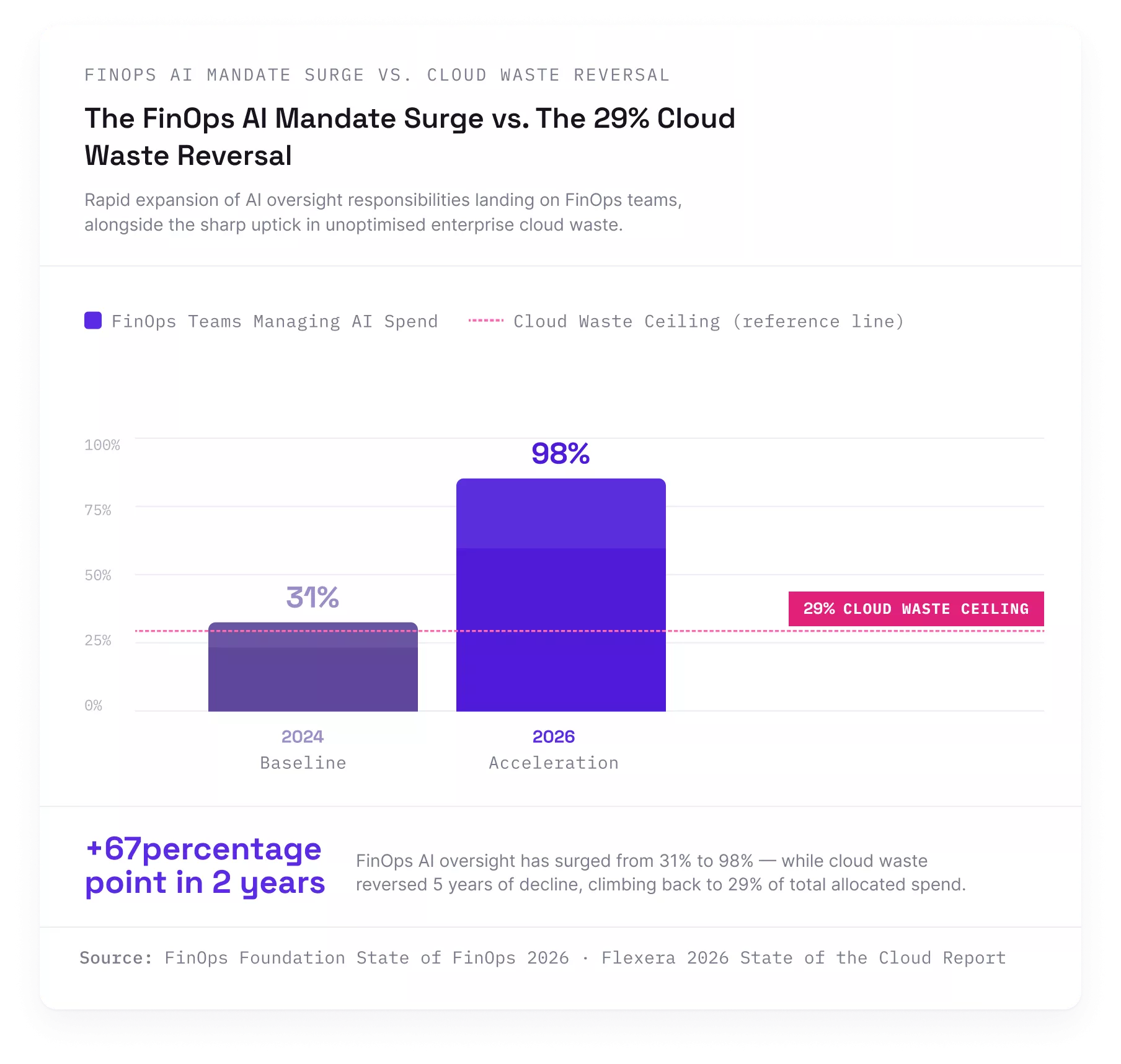
The economic impact of ungoverned AI compute is visible across enterprise balance sheets. According to the Flexera 2026 State of the Cloud Report, estimated corporate cloud waste has climbed back up to 29%, reversing a half-decade optimization trend. Today, nearly a third of total public cloud budgets represents dead capital—consumed by idle GPU instances, orphaned storage blocks, and unmonitored LLM inference loops.
This sudden spike in compute costs has completely transformed the mandate of cloud financial teams. Data from the FinOps Foundation State of FinOps 2026 Report reveals that a staggering 98% of FinOps practices now manage AI spend, up from just 31% two years ago.
Traditional cloud cost management tools—built to track static virtual machines and predictable database instances—are failing under these new dynamics. When developer teams deploy unmonitored AI models across multiple public hyperscalers, cloud spend management becomes an exercise in chasing unexpected billing spikes after the money has already been spent.
2. Building an AI Cloud Governance Framework for Unit Economics
To halt this 29% waste horizon, technology leaders must replace reactive billing reviews with continuous, programmatic controls. Modern cloud cost optimization requires establishing a centralized cloud governance framework focused on three core pillars:
- Tokenomics and Inference Control: Setting hard quotas on API token consumption and routing low-priority model requests to cost-optimized inference tiers.
- Automated GPU Lifecycle Management: Programmatically spinning down idle GPU clusters and development sandboxes during off-peak hours to prevent unmonitored background spend.
- Unit Economics Alignment: Shifting success metrics away from gross budget reductions toward measuring cloud cost per business transaction (e.g., cost-per-prompt or cost-per-active user session).
By aligning cloud architecture with business unit value, organizations can scale AI capabilities without exposing their margins to unpredictable infrastructure bills.
3. Reclaiming Your Cloud Margins with IMSNucleii
Navigating the complexities of multi-cloud architectures and rising AI compute spend requires an operational partner who connects financial engineering with disciplined, day-to-day technical execution. This is the exact value delivered by IMS Nucleii.
As a premier full-stack cloud and value architect, IMS Nucleii provides the specialized engineering and managed cloud support needed to eliminate waste and optimize infrastructure performance:
- Proactive FinOps Engineering: Our cloud architects execute deep-dive TCO audits, deploying automated guardrails, GPU rightsizing rules, and token tracking to eliminate the 29% waste ceiling.
- Multi-Tiered Managed Helpdesk (L1–L3): We take complete ownership of your daily technical support pipeline under a predictable, fixed-cost managed services pricing model, clearing ticket backlogs and insulating your core staff.
- Continuous Governance: We align your hybrid multi-cloud footprint with strict compliance frameworks, ensuring every compute dollar correlates directly with measurable business outcomes.
Stop funding unmonitored cloud waste. Connect with our principal cloud architects at [email protected] to schedule a structured FinOps TCO audit today.
Key Takeaways
- The Waste Reversal: Unmonitored GenAI compute has pushed estimated corporate cloud waste back up to 29%, ending a five-year trend of steady optimization.
- The FinOps Shift: 98% of FinOps teams now manage AI spend alongside traditional infrastructure, up from 31% two years ago.
- Unit Economics: Long-term control requires a proactive governance framework that ties cloud spend directly to business unit outcomes.
Frequently Asked Questions (FAQ)
1. Why do traditional cloud cost management tools fail with GenAI workloads?
Traditional tools track static virtual machines and predictable bandwidth. GenAI introduces non-deterministic LLM inference calls, variable token usage, and heavy GPU cluster demands that cause rapid, unpredictable billing spikes that legacy tools cannot catch in real time.
2. What is the difference between cloud cost reduction and cloud unit economics?
Cloud cost reduction focuses purely on cutting total dollars spent. Cloud unit economics measures the specific infrastructure cost per business output (e.g., cost per completed customer transaction), ensuring spending scales linearly with top-line revenue.
Sources and Citations
- Flexera Research: Flexera 2026 State of the Cloud Report.
- FinOps Foundation: FinOps Foundation State of FinOps 2026 Report.