An executive evaluation of EU regulatory enforcement, executive personal liability, third-party risk, and clean-room recovery architectures. Discover how enterprise technology leaders build continuous cyber resilience frameworks to meet DORA and NIS2 compliance.
For C-suite executives, Chief Information Security Officers (CISOs), and board members across global enterprises, cybersecurity governance has transitioned from a technical risk category into a direct fiduciary liability.
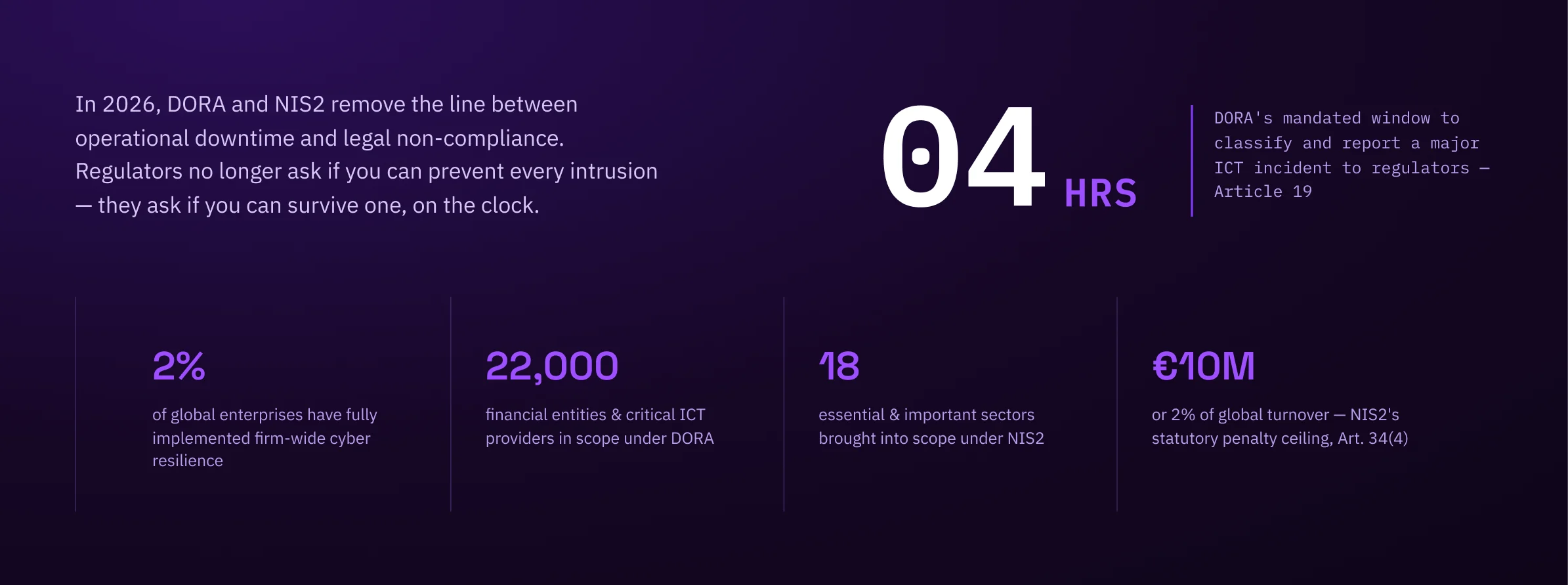
With the full operational enforcement of the Digital Operational Resilience Act (DORA) and the expanded NIS2 Directive (Directive EU 2022/2555), European Union regulators have eliminated the boundary between operational downtime and legal non-compliance.
In 2026, passive defense models that focus solely on breach prevention are legally and operationally obsolete.
Regulators no longer evaluate whether an enterprise can prevent every intrusion. Instead, statutory enforcement centers on operational survivability—the ability of an organization to detect, contain, absorb, and recover from severe ICT disruption within strict, legally mandated timeframes. Building a compliant enterprise requires shifting from static security controls to an automated, continuous cyber resilience framework.
The Regulatory Crucible: DORA, NIS2, and Executive Liability
The enforcement frameworks of DORA and NIS2 establish unprecedented legal accountability for technology leaders and governing boards:
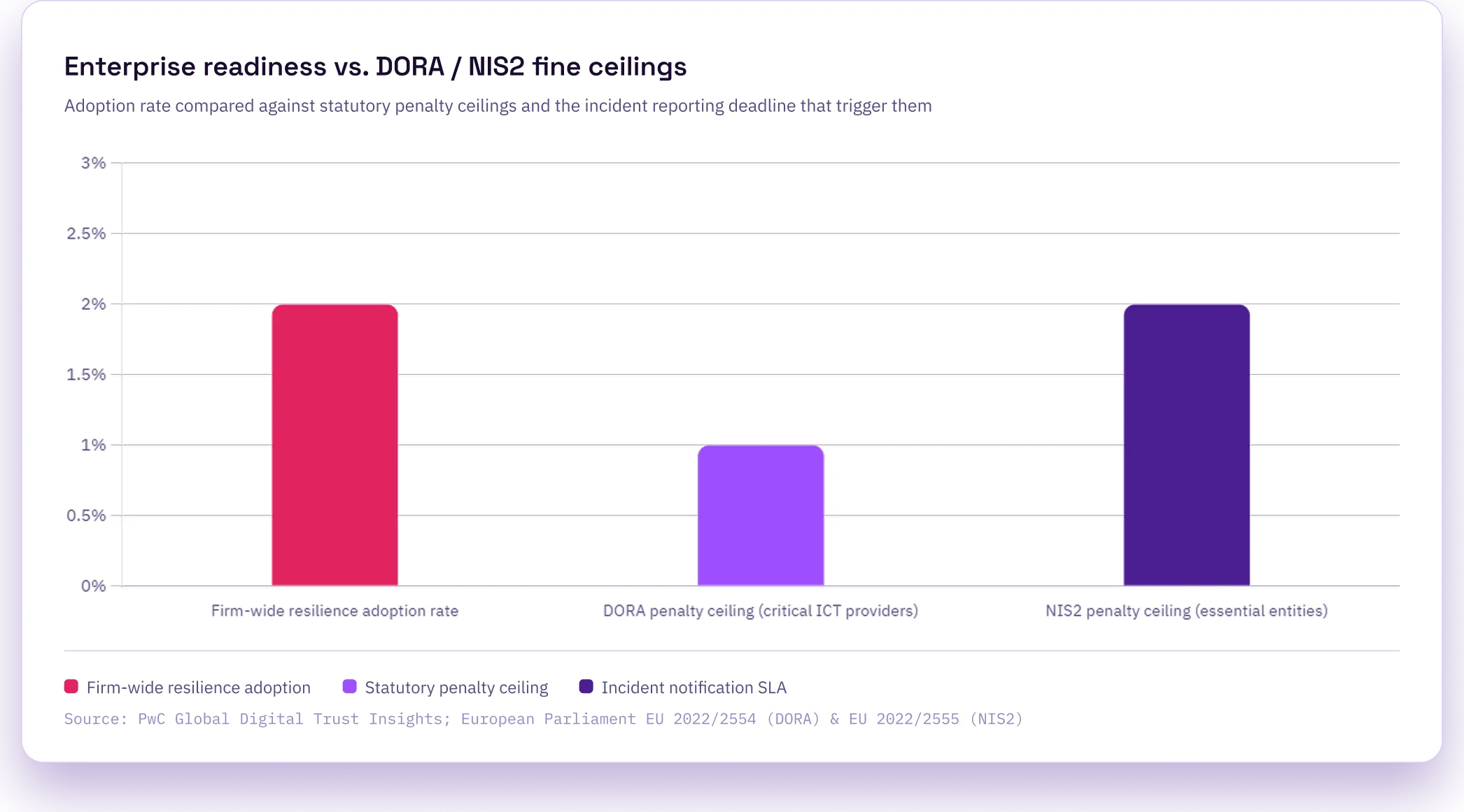
- Digital Operational Resilience Act (DORA): Enforceable across approximately 22,000 financial entities and their critical ICT third-party service providers, DORA mandates strict ICT risk management, 4-hour initial incident notification windows, Threat-Led Penetration Testing (TLPT) every three years, and continuous supply chain auditing. Non-compliance carries statutory periodic penalty payments of up to 1% of average daily worldwide turnover for critical ICT service providers (Article 35(8)).
- NIS2 Directive: Expanding coverage across 18 essential and important sectors—including healthcare, energy, manufacturing, digital infrastructure, and logistics—NIS2 imposes administrative penalties of up to €10 million or 2% of total worldwide annual turnover for essential entities (Article 34(4)). Under Article 20, governing bodies face direct personal liability, including temporary suspensions from executive management roles for compliance failures.
Despite these stringent legal benchmarks, industry readiness remains dangerously low. According to PwC’s Global Digital Trust Insights Survey, only 2% of global enterprise executives report having fully implemented cyber resilience actions across all operational areas of their business. Furthermore, fewer than 50% of CISOs are involved to a large extent in strategic business planning, creating a structural gap between executive oversight and technical execution.
THE CYBER RESILIENCE IMPLEMENTATION GAP vs. STATUTORY PENALTIES
Third-Party and Cloud Vulnerability Deficit
The primary structural bottleneck in achieving compliance under DORA and NIS2 is the expansion of the enterprise digital attack surface through multi-cloud environments and third-party vendor dependencies. Under both frameworks, an enterprise remains legally responsible for operational disruptions caused by its ICT vendors, cloud providers, and software supply chains.
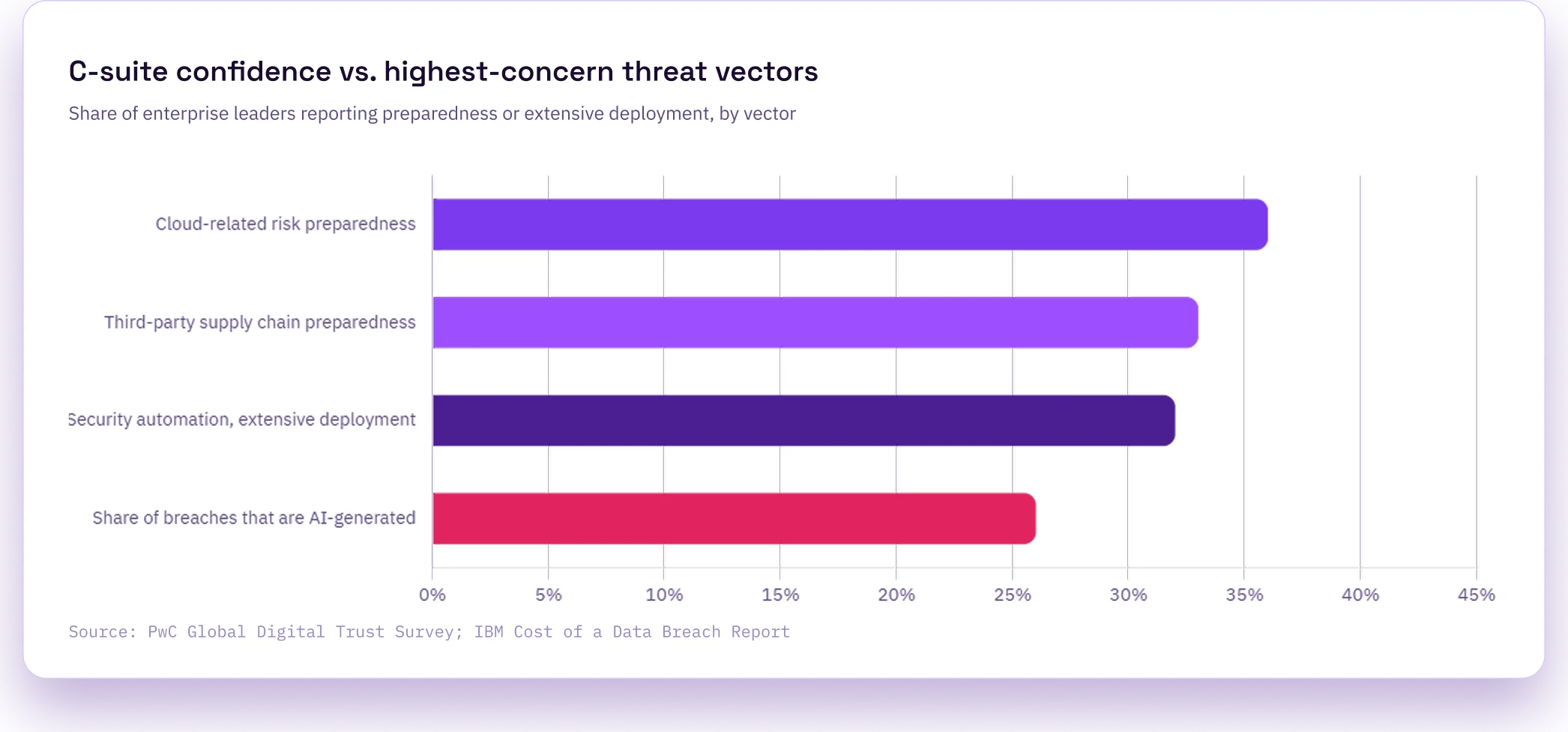
Enterprise threat data from PwC Research reveals a stark preparedness deficit across critical operational domains:
- Cloud Risk Preparedness: Only 36% of enterprise leaders feel fully prepared to address cloud-related cyber threats.
- Third-Party Supply Chain Risks: Only 33% of organizations express confidence in their ability to withstand third-party vendor breaches.
DORA Articles 28 through 30 explicitly mandate that financial entities maintain a centralized Register of Information, evaluate vendor concentration risk, and enforce contractual audit rights, termination clauses, and incident notification SLAs across all external ICT suppliers.
Attempting to manage third-party vendor compliance through manual spreadsheet questionnaires creates blind spots that fail regulatory inspections.
ENTERPRISE THREAT PREPAREDNESS DEFICIT
From Passive Backups to Autonomous Clean-Room Recovery
A major misconception in regulatory compliance is the belief that traditional Disaster Recovery (DR) and immutable backups fulfill DORA and NIS2 business continuity obligations.
Data from the IBM Cost of a Data Breach Report highlights that 26% of malicious enterprise breaches are AI-generated, utilizing autonomous lateral movement, credential harvesting, and stealthy persistence mechanisms. Modern ransomware attacks intentionally target backup catalogs, poisoning restore points with delayed malware triggers weeks before detonating.
If an enterprise restores systems using infected or unvalidated backup snapshots, it reintroduces the threat vector into live production environments, triggering secondary downtime and violating DORA requirements for clean, verified operational recovery.
To meet the 4-hour incident notification window mandated by DORA and minimize operational impact, technology teams must implement Automated Clean-Room Recovery Architectures:
- Continuous Telemetry Scrubbing: Automatically scanning and verifying backup snapshots in isolated, air-gapped sandboxes prior to restoration.
- Deterministic Failover Automation: Replacing manual recovery playbooks with scripted infrastructure-as-code failovers to restore core transaction capabilities in sub-hour timeframes.
- Identity Threat Detection & Response (ITDR): Continuously auditing privileged access, revoking compromised machine credentials, and isolating compromised multi-cloud environments instantly.
INCIDENT RESPONSE VELOCITY & COMPLIANCE TIMELINE
Value Proposition: Operationalizing Cyber Resilience with IMSNucleii
Navigating the regulatory requirements of DORA and NIS2 while maintaining business continuity demands a specialized digital infrastructure and security partner. This is the exact capability delivered by IMS Nucleii.
IMS Nucleii functions as an enterprise value architect and managed security services partner, delivering full-stack automation, compliance engineering, and managed infrastructure support to ensure continuous operational resilience:
- DORA & NIS2 Compliance Framework Engineering: We conduct rigorous gap assessments, construct audit-ready Registers of Information, and implement continuous compliance logging across your hybrid multi-cloud footprint.
- Automated Third-Party Risk Management (TPRM): We integrate automated vendor auditing and real-time posture monitoring tools to satisfy DORA Articles 28–30, eliminating supply chain blind spots.
- Clean-Room Recovery & Infrastructure Automation: We deploy automated clean-room sandboxes, immutable backup verification, and deterministic failover scripts, ensuring sub-hour operational restoration during major disruptions.
- Managed SOC & 24/7 Infrastructure Support (L1–L3): We manage your daily technical operations, threat detection, and incident response under guaranteed SLAs, freeing internal leadership to focus on strategic growth.
Eliminate regulatory exposure and safeguard your operational continuity. Connect with our principal compliance architects at [email protected] to schedule an Executive Cyber Resilience Audit today.
Key Takeaways
- Fiduciary Accountability: DORA and NIS2 convert cyber resilience into board-level liability, with statutory penalty ceilings (e.g., €10M or 2% of global turnover under NIS2 and 1% daily turnover under DORA) alongside personal executive liability under NIS2 Article 20.
- Low Firm-Wide Readiness: According to PwC, only 2% of global enterprise executives have fully implemented firm-wide cyber resilience actions across their organizations.
- Third-Party Exposure: Enterprise vulnerability is concentrated in external dependencies, with only 33% of leaders feeling prepared for third-party breaches.
- Clean-Room Requirement: Traditional backups are vulnerable to backup poisoning; meeting DORA SLAs requires automated, clean-room snapshot verification and sub-hour failover execution.
Frequently Asked Questions (FAQ)
What is the primary difference between DORA and NIS2?
DORA (Digital Operational Resilience Act) applies specifically to the financial sector (~22,000 EU financial entities and their critical ICT suppliers), establishing precise rules for ICT risk, 4-hour incident reporting, and penetration testing. NIS2 applies broadly across 18 critical sectors (energy, healthcare, manufacturing, digital services) and introduces explicit personal liability for management bodies under Article 20.
Why are immutable backups insufficient for DORA compliance?
Immutable backups prevent data deletion, but they do not prevent malware poisoning. Modern cyber threats infect backup catalogs weeks before detonation. DORA requires validated operational recovery, which necessitates automated clean-room telemetry scrubbing to ensure restored data is uncompromised. .
How does IMSNucleiiassist with third-party ICT vendor risk management?
IMS Nucleii automates vendor risk discovery, establishes a centralized Register of Information, monitors real-time ICT supplier security postures, and embeds contractual compliance guardrails required under DORA Articles 28–30.
Sources and Citations
- European Union Statutory Portal: Review official legal requirements in Official Journal of the EU: DORA Regulation (EU 2022/2554) and NIS2 Directive (EU 2022/2555).
- PwC Global Research: Access enterprise security benchmarking data in the PwC 2025 Global Digital Trust Insights Survey.
- IBM Security: Review global breach and automation metrics in the IBM Cost of a Data Breach Report.
- Gartner Research: Examine CISO technology forecasts in Gartner Information Security Forecasts.
- IMS Nucleii Operations Hub: Explore enterprise compliance architectures at the IMS Nucleii Enterprise Managed Security and Digital Infrastructure Hub.