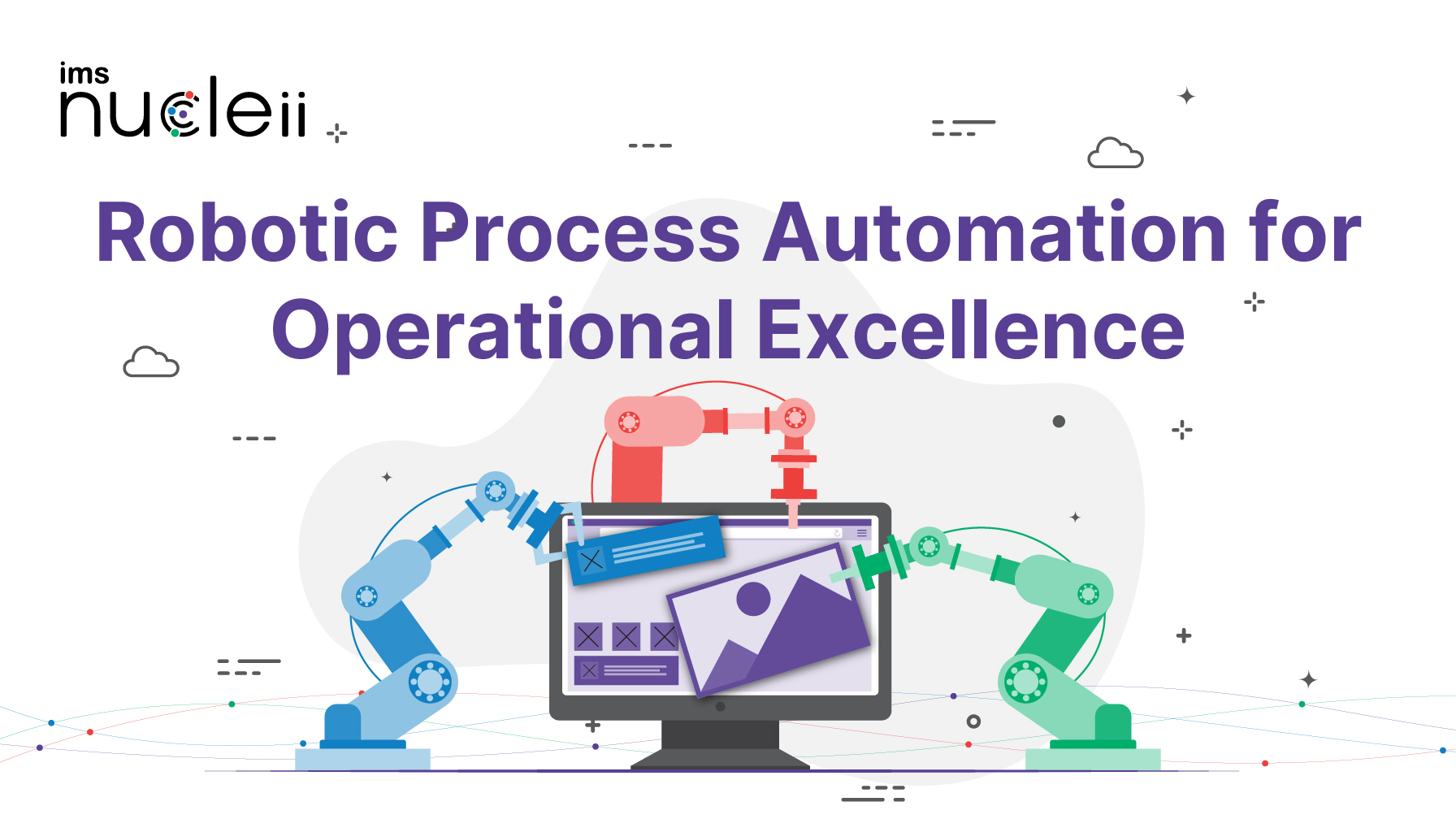
Organisations are constantly seeking new ways to improve productivity, eliminate inefficiencies, and reduce operating costs. Robotic Process Automation (RPA) has emerged as a powerful tool to help companies streamline repetitive workflows and unlock higher operational efficiency.
At IMS Nucleii, we harness RPA to deliver tangible business outcomes for our clients through intelligent automation.
What is Robotic Process Automation?
Robotic Process Automation, or RPA, refers to the use of software bots to automate highly repetitive, rule-based digital tasks. These bots mimic human interactions across systems, applications, and databases, executing tasks quickly and accurately without the need for manual intervention.
Unlike traditional automation, RPA doesn’t require changes to existing infrastructure. It integrates seamlessly with enterprise tools, which makes it both scalable and cost-efficient. RPA enables businesses to handle large volumes of tasks with greater speed and precision while freeing up teams to focus on more strategic responsibilities.
Robotics Process Automation Delivers Business Value
The benefits of robotics process automation go far beyond time savings. RPA significantly reduces manual errors, increases process consistency, and improves compliance. Businesses can expect a dramatic improvement in turnaround time for processes like invoice validation, data entry, payroll processing, and customer onboarding.
RPA also plays a key role in data handling and reporting. Whether it’s extracting, validating, or consolidating information, RPA ensures accuracy across all datasets, especially important for compliance-heavy sectors like finance, heralthcare, and IT services.
Cost Saving and Resource Optimisation
Robotic Process Automation is not just a tool; it’s a strategic lever for optimising both costs and resources. By automating high-volume, rule-based tasks, businesses can significantly reduce their operational expenses and improve workforce productivity.
RPA minimises the need for manual intervention in transactional processes. This leads to fewer human errors, faster processing times, and lower overheads. The result? Teams can redirect their focus to high-value, client-centric work that drives growth and innovation.
For organisations considering RPA BPO or RPA outsourcing, this approach enables flexible scaling without expanding internal resources. Whether it’s automating accounts payable for a finance team or streamlining IT helpdesk workflows, outsourced Robotic Process Automation services offer agility, accuracy, and round-the-clock performance.
IMS Nucleii leverages this model to help clients modernise their back-office operations. We align automation strategies with business KPIs to ensure long-term ROI and sustainable operational efficiency.
RPA Implementation for Business Transformation with IMS Nucleii
At IMS Nucleii, our approach to RPA is strategic and customisable. By assessing a client’s existing workflow, identifying automation-ready processes, and mapping out opportunities to deploy intelligent bots. From there, scalable RPA solutions that are tailored to the client’s specific business goals and systems.
Once the automation roadmap is defined, RPA experts develop, test, and deploy bots using leading platforms, ensuring secure, compliant, and scalable implementations. Each bot is configured with defined rules and triggers to minimise manual oversight while maximising process throughput.
Integrate RPA into our broader Managed IT, Co-managed IT, and SaaS services, creating a unified digital operations strategy. This convergence allows our clients to benefit from intelligent automation, cloud scalability, and real-time data analytics, making RPA not just a cost-saving tool but a key driver of digital transformation.
Proven. Scalable. Compliant. That’s RPA at IMS Nucleii